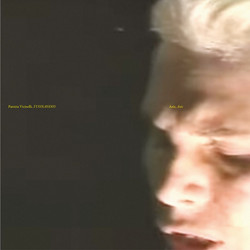
** 200 Copies. Includes printed inner sleeve with lyrics and credits. ** Cut it up. Stick it back together wrong. This is Magazzini Criminali at their most deliriously inventive - a Florence-based theater collective that understood William Burroughs's cut-up method as an operational principle for sound itself. Released in 1983, Notti Senza Fine is their second LP, a document where theater becomes indistinguishable from electronic collage, where the stage disappears into tape loops and reassembled vocal fragments.
Federico Tiezzi (director, electronics), Sandro Lombardi (text, voice), and Marion d'Amburgo (voice) weren't making songs. They were assembling something else entirely. Unlike Crollo Nervoso three years earlier, Notti Senza Fine cuts loose from theater - the cut-up accelerates into something almost vertiginous, fragments layering so densely you can barely trace their origins. The screams of Antonin Artaud collide with voices and instrumental shards from everywhere - tribal percussion that sounds like field recordings, sax, synthesizers - meshing and fading into each other without resolution. What the jazz critic and cultural theorist Franco Bolelli called "planetary music" emerges: no stage, no narrative, just Lombardi, Tiezzi, d'Amburgo, and Julia Anzilotti moving through a constantly shifting sonic terrain. Like Henri Chopin's sound poetry pushed through the entire world's radio frequencies at once, voices become texture rather than meaning. The track titles - Tangeri 400 Km. Nord, Honolulu Vento Solare, Kabul-Febbre, Al Hoceima 1943 - map locations that barely hold shape in the sound. The album itself becomes an "object-significant" - distinguished not just as a vehicle for music but as a physical thing.
Jon Hassell's processed Fourth World trumpet runs through the mix like a ghost signal you're always about to recognize - his voice sampled and appropriated, transformed beyond recognition into the general chaos. Three years later, fresh from winning an Ubu Award for scoring Magazzini Criminali's Sulla Strada at the Venice Biennale, Hassell would become a direct compositional collaborator - commissioned to write the music, not sampled from. But here in 1983, on Notti Senza Fine, his presence is something more spectral: stolen, recombined, cut into material that refuses to cohere.
There's an ironic swagger to it, a specifically Italian 80s irreverence toward the very idea of "proper" experimental music. The samples don't announce themselves solemnly. They arrive like overheard conversations in a crowded room, fragments refusing to cohere into meaning. Sudden jolts. Radio noise. Voice becoming pure texture. What results isn't theater music or electronic composition - it's something closer to sonic gossip, art half-amused by its own pretensions.
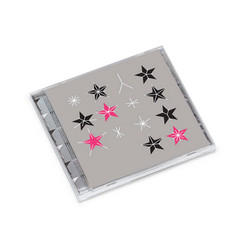
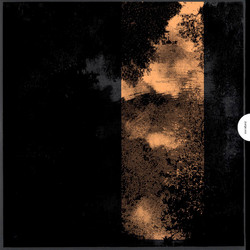
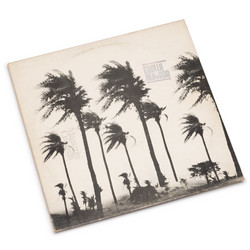
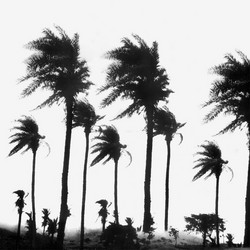
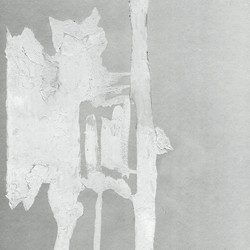
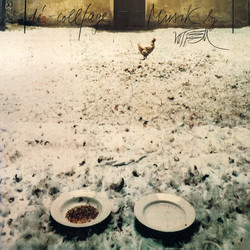
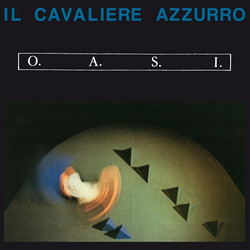
The original Riviera Records pressing (RVR-4) has been nearly impossible to find for decades. Originally destined for the Cramps label, the album eventually emerged on this small Roman independent - Riviera Records, founded just the year before by Amedeo Sorrentino, Federica Roà, and jazz musician Maurizio Giammarco. Mario Schifano handled the cover design, his graphic work bringing visual weight to what might otherwise remain theater ephemera.
This is collage as genuine refusal. Not quotation, not homage - transformation. The practice that would eventually feed into everything from industrial noise to contemporary sample culture, but arriving here as something stranger: theater that understood cutting and pasting weren't metaphors but literal sonic tactics.
Comes with printed inner sleeve with lyrics and credits. 200 copies