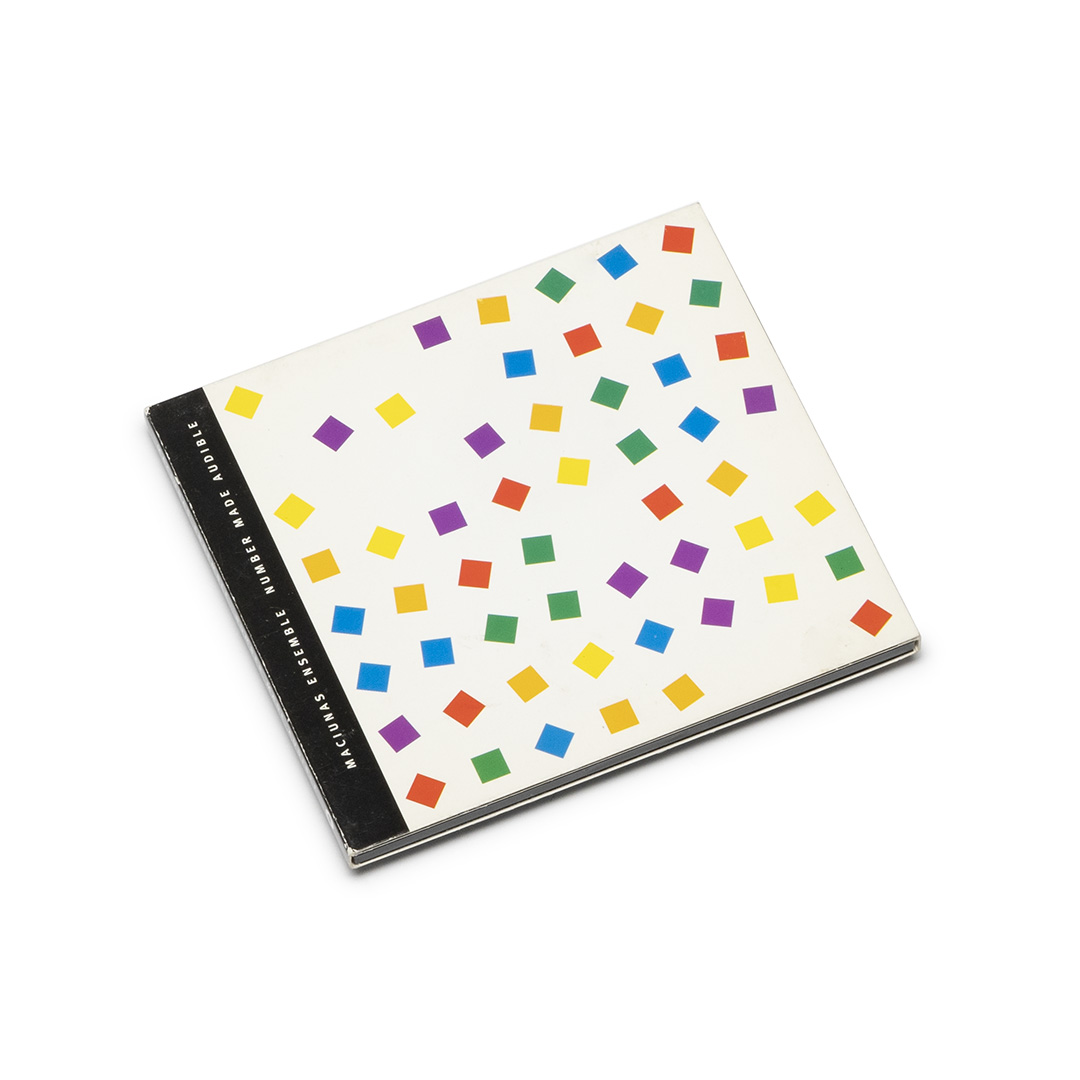
Maciunas Ensemble
Number Made Audible
FormatCDLabelHet ApollohuisGenreSound Art
Out of stock
Tracked express shipping from Italy, no customs or import VAT in the EU. Shipping costs
Named in tribute to Fluxus-founder George Maciunas, the Maciunas Ensemble's Number Made Audible stands as one of the most radical documents of sound art to emerge from the Netherlands in the 1990s. Originally released by Het Apollohuis in 1993, this CD captures eleven pieces that transform numerical relationships into living sound through invented instruments: Duochords, Spring Strings, Musical Bows, Guitars with Tails, Tubular Aluminum Monochords.
Founded in 1968 by Paul Panhuysen, Remko Scha and Jan van Riet, the Maciunas Ensemble embodied George Maciunas's vision that music should make the generation of sound itself audible. Working alongside Mario van Horrik, Horst Rickels, and Leon van Noorden, Panhuysen translates mathematical proportions into acoustic phenomena—string lengths become frequency ratios, harmonic series unfold as drone compositions, Pythagorean intervals manifest as physical architecture. Each piece follows strict numerical systems: predetermined tunings, calculated string divisions, algorithmic bow movements that generate complex overtone patterns from simple mathematical rules.
What strikes most forcefully is how these rigid structures produce such organic results. The ensemble's purpose-built instruments exploit the physics of resonance—aluminum tubes vibrating at precise frequencies, springs subdividing pitch according to tension ratios, bowed strings generating harmonic cascades that follow the mathematics of wave interference. This isn't abstract theory but embodied knowledge: you can hear the numbers singing through wood and metal, making Boethius's ancient principle of music as "number made audible" startlingly literal.
In our current moment of algorithmic composition, Number Made Audible feels prophetic. The Maciunas Ensemble reminds us that all sound is mathematics—frequency, amplitude, duration—transformed into sensory experience. Music that doesn't age because it speaks the universal language of proportion and resonance.
Release notes
Instruments used include: Duochords, Spring Strings, Musical Bows, Guitars with Tails and Tubular Aluminum Monochords. The booklet provides descriptions of these instruments. Edition: 1000 copies CD manufacturing: DADC Salzburg. © Maciunas Ensemble, Het Apollohuis 1993 Packaged in six-panel Digipak with 12-page booklet.
| 1 | Leaping Berates | 4:49 | |
| 2 | A Wide, White World | 6:14 | |
| 3 | See What I Hear | 1:24 | |
| 4 | The Four Daltons | 13:19 | |
| 5 | Hear What I See | 2:14 | |
| 6 | Macrosonography | 17:22 | |
| 7 | Bottled Voices | 1:17 | |
| 8 | Long String Choir | 2:21 | |
| 9 | Talking Ropes | 4:10 | |
| 10 | Blowing | 6:30 | |
| 11 | Arcs En Ciel | 5:10 |
- Opera
- Design
- Ton Homburg
- Design
- Paul Panhuysen
- Design [Cover Design], Edited By [Editor], Mastered By, Performer [Maciunas Ensemble]
- Maciunas Ensemble
- Edited By [Editor], Recorded By
- George Maciunas
- Liner Notes
- Betty Eversdijk
- Liner Notes [Copy Editor]
- Lucas Van Beeck
- Liner Notes [Translation]
- Frank van Donkersgoed
- Mastered By
- Jan van Riet
- Performer [Maciunas Ensemble]
- Leon van Noorden
- Performer [Maciunas Ensemble], Typography [Text], Illustration [Drawings]
- Mario van Horrik
- Performer [Maciunas Ensemble]
- Paul van den Nieuwenhof
- Photography By
- Peter Cox
- Photography By
- Pieter Boersma
- Photography By


