Flutist and composer Taiga Ultan announces the release of Shade Zero, her debut full-length album out June 26 on Kou Records and recorded, mixed, and produced by Randall Dunn (Anna von Hausswolff, Annea Lockwood, Danny Elfman). Structured as a three-part work, the album traces a gradual transformation from virtuosic flute performance rooted in classical discipline to extended techniques, spoken language, and poetic reflection. At the center of Shade Zero is an investigation into the relationship between freedom and rules in music-making. Rather than rejecting structure outright, Ultan constructed strict compositional systems for herself and then deliberately misused and dismantled them. By making these rules explicit—and then pushing against them—she sought to move beyond familiar sound worlds and inherited assumptions about what “free” music should be.
“Without rules equals freedom?” Ultan reflects. “That reminds me of saying ‘God get gone’ over and over again—it only brings him closer. The way out of rules is through them.” The album unfolds across three interconnected movements. It begins with highly controlled, tonal flute playing that reflects Ultan’s extensive musical training. A former student of George Garzone and flutist Claire Chase, she brings both improvisational rigor and contemporary experimental technique to the instrument. Gradually the music destabilizes, opening into breath sounds, multiphonics, and extended techniques that push the flute toward unfamiliar textures. In the final movement, Ultan’s voice enters the work directly through spoken texts, folding language and sound into a single evolving form. The poetry carries echoes of spare modernist traditions—at times recalling the distilled attention of Lorine Niedecker or the recursive logic of Samuel Beckett—where repetition and plainspoken language become structural forces within the music itself.
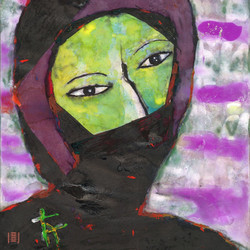
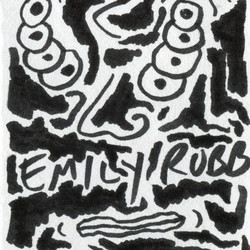
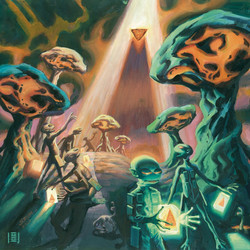
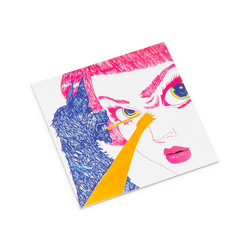
The compositional process behind Shade Zero involved writing detailed scores that functioned almost like maps—technical instructions designed to guide performance toward unpredictable outcomes. By intentionally misusing these systems, Ultan turned her own musical training into a generative tool, allowing new techniques and sonic possibilities to emerge. Recorded with Dunn in a setting that foregrounds physical presence and acoustic detail, the album captures the flute in intimate proximity: air, tone, and silence becoming equal partners in the unfolding music. The album's visual world extends its inquiry into form and transformation. Front cover artwork is by video game character designer Tushar Dobriyal, with a commissioned back cover portrait by Saprophial. Custom "Taiga Ultan" logos by Aaron Turner (Neurosis, ISIS, Sumac).
Ultan, who now lives and works in rural Maine, approaches this debut as a decisive shift toward a self-defined artistic practice. Across its arc, Shade Zero becomes both an inquiry and a declaration—music that questions the structures it inherits while quietly inventing new ones.


![Σ [sigma]](https://cdn.soundohm.com/data/products/2026-10/a0550686140_10-jpg.jpg.250.jpg)