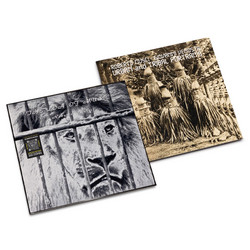
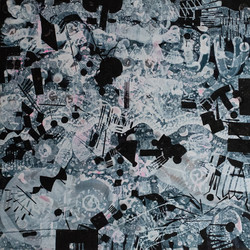
Much-needed repress! Rituals of The Last Dawn finds Saba Alizadeh at a point where tradition and experiment no longer sit opposite each other, but share the same breath. A key figure in contemporary Iranian music, Alizadeh has spent the past years bending classical Persian lineages into new shapes, using kamancheh, electronics and field recording as parallel vocabularies rather than opposites. Here, that approach flowers into two extended pieces that feel less like “tracks” and more like ceremonies stretched across an LP side, each one listening as much as it speaks.
The title suggests finality, yet the music inhabits a more ambiguous threshold. Dawn, in these 40 minutes, is both promise and exhaustion: the pale light after a long night, but also the knowledge that another cycle of struggle is already beginning. Alizadeh writes for an audience that might file him under “world music,” ambient or drone, but he lets those categories dissolve into something more intimate. Long tones hover in the air, microtonal inflections spiral around a centre that never quite fixes, and electronics blur the edges of the acoustic instruments until their source becomes secondary to their emotional charge. It is music that asks for open ears rather than specialist codes, and rewards that openness with an unusual clarity of feeling.
Crucially, Rituals of The Last Dawn is not a solitary studio construction. The album is created in the moment with close collaborators, each side a distinct constellation of voices. On First Ritual, Italian musician Pietro Caramelli folds guitar and electronics into Alizadeh’s sound world, dissolving the instrument into glimmers, harmonics and barely‑there chords that act more as light sources than as accompaniment. The interplay feels like a shared improvisation in slow motion: gestures arise, circle one another, recede, leaving behind a residue of resonance that becomes part of the piece’s memory. On the flip, Last Ritual welcomes Liew Niyomkarn on lap steel and electronics, pulling the music toward a different horizon. The lap steel’s gliding tones echo the curves of Persian melody while also opening a subtler, transcontinental melancholy, a sense of distance measured not in geography but in lived time.
What emerges across both pieces is a kind of devotional minimalism, but without the rigid grids often associated with the term. Structures are flexible, breathing; silence is treated as a full participant, not a gap to be filled. Alizadeh lets sounds decay fully, allowing the grain of the room and the circuitry to colour the tail of each note. In this expanded field, the smallest shift - a bow leaning a little harder into the string, a new overtone arriving in the feedback - starts to feel monumental. The music draws equally on ambient spaciousness, the focused intensity of drone and the narrative weight of classical improvisation, yet it never settles into a single idiom. Instead it behaves like a ritual in real time: fragile, contingent, utterly present.
In bitter times, Rituals of The Last Dawn functions as a kind of necessary sustenance, not because it offers escapism, but because it holds space for grief, resilience and quiet hope in the same frame. It is a record that can sit on a shelf next to contemporary ambient and experimental releases, but it carries with it the weight of a specific history and a specific struggle, folded into sound rather than spelled out. Above all, it stands as a clear statement from one of Iranian music’s most distinctive voices: that listening itself can be an act of care, of resistance, and of beginning again, even when the day ahead looks impossibly dark.