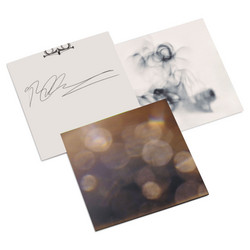
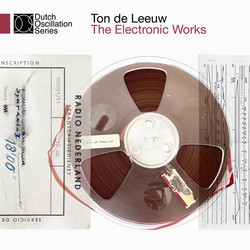
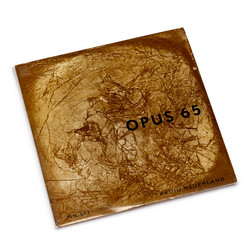
Small repress soon available - Dutch Oscillation Series (DOS) proudly announces the release of a box set featuring the complete electronic works of Ton de Leeuw (1926–1996). This publication marks the first instalment in a new series that brings the history of Dutch electronic music to life for a broad audience. The official presentation will take place on Saturday, 12 September, during the Gaudeamus Festival for contemporary music in Utrecht.
Unique discoveries from the archive. For far too long, twentieth-century Dutch electronic music has remained hidden away in dim archives, only occasionally accessible under optimal conditions. Many compositions have not been heard for decades, perhaps after being presented to an audience only once. For this project, the original tapes were carefully traced in basements and archives, including the mysterious work Chronos, which was rediscovered in the collection of the Netherlands Music Institute (NMI). Even close collaborators of De Leeuw were unaware of the existence of Chronos. Another highlight of this release is the radiophonic oratorio Job (1956), which was awarded the Prix Italia radio prize by broadcaster Rai. The recordings were digitised by experts at the Institute of Sonology and the Instituut voor Beeld en Geluid (Netherlands Institute for Sound and Vision). The music was then meticulously restored and mastered in the studio of Jos Smolders (EARLabs), in accordance with modern standards, while strictly adhering to the composer’s original artistic intentions.
The edition includes eight works composed between 1956 and 1982. The collection is released as a deluxe LP and CD box set and is also available via streaming and as high-resolution downloads. For an optimal listening experience, originally four-channel works such as Elektronische Studie (Electronic Study) and Antiphonie (Antiphony) are available as special Dolby Atmos downloads, allowing listeners to experience at home the unique spatial sound world envisioned by Ton de Leeuw.
Ton de Leeuw was one of the most influential Dutch composers of the twentieth century. A thinker with a distinctly cosmopolitan outlook, he immersed himself deeply in musical cultures from India, Japan, and Indonesia, among others. His work consistently sought to bridge Eastern and Western musical traditions and concepts. In addition, De Leeuw enjoyed a distinguished academic career. He served for many years as senior lecturer and director at the Amsterdam Conservatory and was affiliated as a senior research fellow with the University of Amsterdam. His book Muziek van de twintigste eeuw (Music of the Twentieth Century) remains a standard reference work.