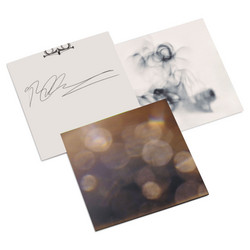
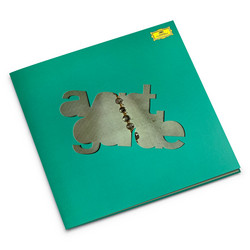
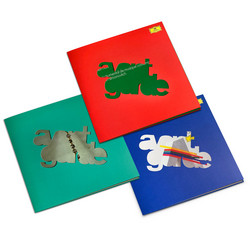
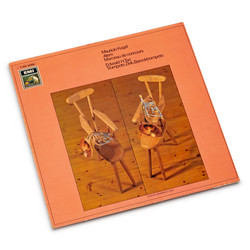
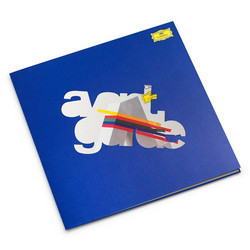
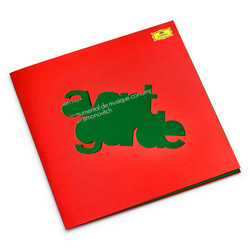
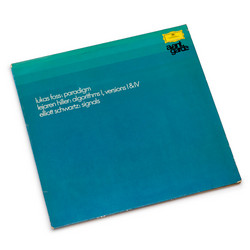
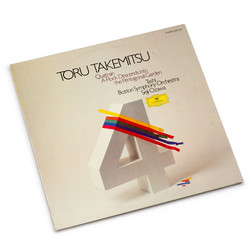
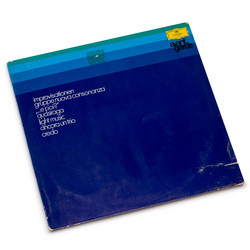
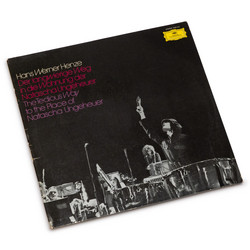
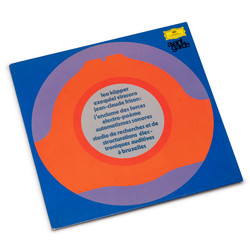
Limited and numbered edition, featuring original artwork and a newly designed, beautifully crafted collector’s sleeve with new liner notes by Bradford Bailey, and pressed on 180g vinyl. Includes hi-res audio download. Among the most playful and pointed entries in Deutsche Grammophon's legendary Avantgarde series, Mauricio Kagel's Exotica returns to vinyl - a work that turns the Western fascination with the music of elsewhere into a piece of high comedy and, beneath the laughter, a quietly devastating critique. Born in Buenos Aires in 1931 to Russian Jewish émigrés who had fled the aftermath of the October Revolution, Kagel settled in Cologne in 1957 and became one of the great conceptual provocateurs of postwar music. For him theatre, gesture, and absurdist humour were never decoration but the substance of the work itself, a way of turning audience expectation back on the listener. By the early 1970s he stood, alongside John Cage, as one of the most pointed counterweights to the orthodoxies of the European avant-garde.
Composed in 1971-72 on commission for the cultural programme of the Munich Olympic Games, Exotica takes a single, mischievous premise to its limit. Six performers are handed instruments drawn from outside the European tradition - some two hundred in all, gathered from museum and ethnographic collections - and asked to play instruments for which they have no training at all. At the 1972 premiere those performers were among the most accomplished figures in new music, including Vinko Globokar, Siegfried Palm, Christoph Caskel, and Michel Portal: virtuosi deliberately stripped of their virtuosity and sent back toward a raw, first-principles state of music-making.
What results is a teeming, unstable music of chant, breath, struck and bowed and blown sound, the instrumental lines notated as continuous rhythmic monody while the voice takes precedence throughout. Rather than weaving borrowed modes and rhythms into his own language, Kagel pursued the opposite: imitation calibrated by the score from faithful to deliberately, comically wrong, the players left to invent in a register somewhere between reverence and panic. It is funny, unsettling, and genuinely uncomfortable in its questioning of who is permitted to play what, and on whose terms - a piece that interrogates the idea of the "exotic" while refusing to resolve it.
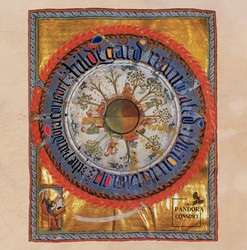
For this edition the original analogue ¼-inch two-track master tapes have been newly mastered and cut by Rainer Maillard and Sidney Claire Meyer at the Emil Berliner Studios, pressed on 180g vinyl, with original artwork inside a newly designed collector's sleeve and new liner notes by Bradford Bailey. A limited, numbered edition of a singular and increasingly hard-to-find document of postwar experimentalism.