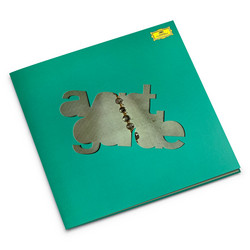
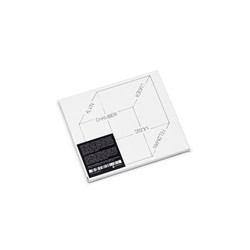
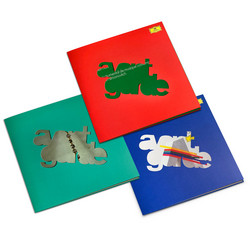
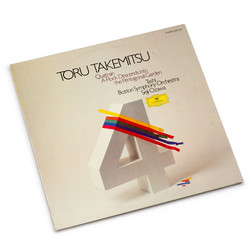
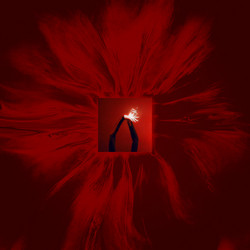
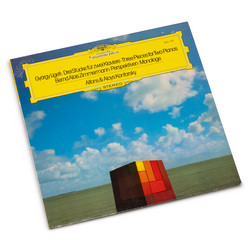
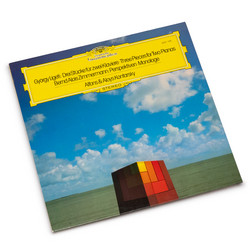
Containing what are easily among the important and celebrated works by Tōru Takemitsu, arguably Japan's most important and celebrated 20th Century avant-garde composer, 'Quatrain / A Flock Descends Into The Pentagonal Garden' was originally issued by Deutsche Grammophon in 1980. Had the Avant-Garde series not concluded nine years prior, it certainly would have been contained within its ranks. Illuminating a crucial juncture within the composer's career which not only found him fully embracing acoustic instruments over the electronics that had helped define his earlier efforts, but also returning to distinctly Japanese cultural touchstones, having formerly sharply rejected them due to his own experiences during the Second World War. Both works comprised by the LP embody Takemitsu's emerging desire to "develop into two directions at once, as a Japanese in tradition and as a Westerner in innovation" further stating that "My music is like a garden, and I am the gardener. Listening to my music can be compared with walking through a garden and experiencing the changes in light, pattern and texture".
Quatrain, composed in 1975 for clarinet, violin, cello, piano and orchestra, and recorded in 1977 by the American ensemble Tashi and the Boston Symphony Orchestra, carves a spacious expanse of tonal and timbral events, imbued with a starling energy. The composer compared the piece to a "picture scroll unrolled; the scene changes successively without a break. It emulates the relationship between a garden and a person walking through it" going on to elaborate, in his liner notes for the album's original 1980 release, that the work resembles "the tradition of 'EMAKI' (a series of scenes painted on a long roll), whereby each musical idea is independent yet permeates its neighbor, keeping an indefinite frame".
Composed only two years later, where the imagined garden of Quatrain unrolls with allusions to linearity, A Flock Descends Into The Pentagonal Garden emerged as an expression of Takemitsu's rapidly advancing considerations connected to time and space, unfurling as a vast and open tonal field within which its events transpire: "It's not a linear experience at all. It is circular - one always comes back". Inspired by a dream involving a flock of birds descending into a five-sided garden, the composer would later describe the work as a "shifting panorama of scenes in which the main motif - introduced by the oboe and representing the so-called 'Flock' - descends into the harmonious tone-field called the 'Pentagonal Garden', created mainly on the strings."
On the simplest set of terms, these two works, collectively bound on complementing sides of the LP, not only represent some of the most important experimental efforts of their era, within and without Japan, but also signify a crucial shift in the sense of possibility of what sound can express.