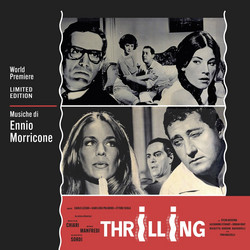
*Much needed second edition repress!!* Thrilling restores Ennio Morricone’s original soundtrack to the 1965 omnibus film of the same name, presenting the complete music he composed for its three episodes, directed by Ettore Scola, Carlo Lizzani and Gianluigi Polidoro. Rather than a grab‑bag of cues, the score plays like a tightly wound suite in multiple moods, reflecting the film’s shifts from black comedy to crime, anxiety and absurdity. Long buried in the shadows of his more famous Western and giallo work, this music reveals Morricone in a moment of rapid evolution, already folding together cinema‑ready drama, jazz sophistication and experimental curiosity.
At the heart of Thrilling is a balance between heavy and light. On one hand, the writing taps into classic suspense language: tense strings, stalking bass lines, harmonies that shade from sly to ominous. On the other, Morricone leans into some of his grooviest mid‑60s instincts. Themes ride on lithe, swinging rhythms; brass riffs punctuate like knowing winks; certain passages move with a breezy, almost lounge‑adjacent swagger. Flute and saxophone take prominent roles, not just as solo colours but as structural voices, trading lines and intertwining over rhythm sections that owe as much to small‑combo jazz as to traditional studio orchestration. That combination gives the score an urban, nocturnal sheen - music that could easily spill from a nightclub doorway onto a rain‑slick street.
Morricone’s “floating” style is very much in evidence: melodies are often suspended over shifting harmonic beds, instruments drift in and out of focus, and the sense of metre sometimes loosens just enough to feel like the music is hovering a centimetre above the ground. Underneath that apparent ease, the arrangements are intricate. Lines are doubled and shadowed in surprising ways, small percussion details and piano figures knit cues together, and recurring motifs are smuggled into different contexts so that the score feels unified even as it travels between comedic sharpness, sly romance and genuine menace. Bruno Nicolai’s direction ensures that the ensemble moves with precision through these changes, giving the music a sharp profile even in its most delicate moments.
What sets Thrilling apart from much of Morricone’s contemporaneous work is the degree of sonic experimentation threaded through it. Alongside the brass, reeds and rhythm section, you hear “odd” sounds: unexpected percussive scrapes, prepared‑piano‑like attacks, unusual wind effects, vocal fragments or electronic‑adjacent textures that briefly bend the cues into stranger shapes. These elements never feel gratuitous; instead, they act as small destabilising jolts, underlining the film’s off‑kilter humour and psychological shadows. The darker harmonies and sudden textural ruptures that surface here bear the unmistakable stamp of a composer already thinking beyond conventional genre scoring.
Collecting this almost unheard score in full allows Thrilling to be heard as more than a period curiosity. It becomes an essential chapter in Morricone’s 1960s output, a place where his love of jazz, his appetite for avant‑garde technique and his instinct for instantly memorable themes converge under the sign of suspense. For long‑time admirers, the album offers a fresh angle on a familiar giant, revealing how far he was willing to push form and colour even on ostensibly “light” projects. For new listeners, it is a compact, vividly orchestrated entry point into a body of work where thrill, wit and genuine musical daring are inseparable.