
Karlheinz Stockhausen
Karlheinz Stockhausen (1928 to 2007), born in Mödrath near Cologne, wrote more than three hundred works, from orchestral and chamber pieces to pure electronic music, and did more than anyone to shape the postwar avant-garde. His Studie I (1953) was the first piece composed entirely from sine waves, Studie II the first electronic score to be notated and published, and Gesang der Jünglinge (1956) and Kontakte (1960) remain the classics of the Cologne studio.
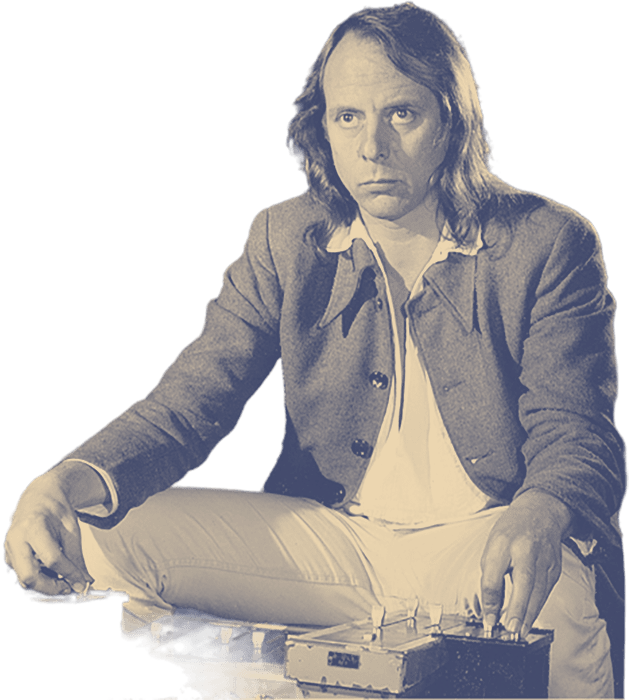

Stockhausen on Music (Book)
*2022 stock* If a genius is someone whose ideas survive all attempts at explanation', writes the well-known contemporary musicologist Robin Maconie, 'then by that definition Stockhausen is the nearest thing to Beethoven this century has produced. Reason? His music lasts. With penetrating philosophical and spiritual insights Stockhausen describes, in this collection of lectures and interviews conducted in English, a whole new universe of sounds and events. Stockhausen's uncompromising attitude to…
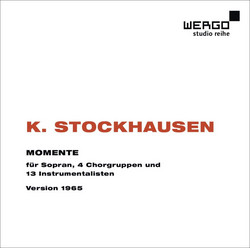
Momente - Version 1965
With the legendary “Studio Reihe Neuer Musik” series, Wergo created a trademark of advanced contemporary music in the Sixties of the past century already. On the occasion of its 50th anniversary, the label now releases these highlights of 20th-century music history in an excellent sound quality on CD for the first time."Studio Reihe” now continues with a work by Karlheinz Stockhausen: His “Momente” [Moments] for soprano, four choral groups, and thirteen instrumentalists have not been designed a…
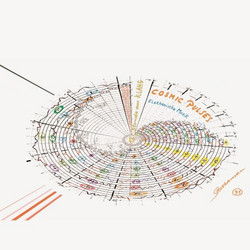
Cosmic Pulses
Karlheinz Stockhausen – “Cosmic Pulses” is the last electronic composition by Karlheinz Stockhausen, and it is number 93 in his catalog of works. It is the 13th "hour" of Stockhausen's originally-planned 24-part cycle Klang ("Sound") which is based on the 24 hours of the day. This electronic work is composed of 24 layers of synthesizer-generated melodic material, with each layer having a different speed and pitch register. The layers enter one by one, starting from the lowest/slowest layer, a…
Elektronische Musik Von Sirius
* 2021 Stock * Packaged in two double CD cases suited in a card slipcase along with a 46 pages booklet that includes texts in german and english. Karlheinz Stockhausen – “Elektronische Musik Von Sirius” Realisation at the Studio for Electronic Music of the West German Radio in Cologne from July 1975 to March 1977 using an EMS Synthi 100 synthesizer.. "In connection with the composition ‘Sternklang’ I closely watched the star constellations in Kürten. From my study as well as from the kitchen my …
Musik Für Posaune Und Euphonium
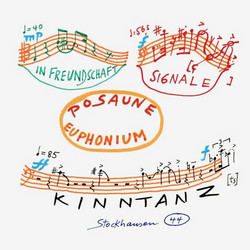
*2022 Stock.* Karlheinz Stockhausen – “Musik für Posaune und Euphonium (Music for Trombone and Euphonium)” In Freundschaft (Für Posaune) for trombone – Signale Zur Invasion (1992) for trombone, electronic music and sound projectionist – Kinntanz (1983 / 89) for euphonium, percussionist, synthesizer player and sound projectionist "Stockhausen’s birthday gift composition for Suzanne Stephens - In Freundschaft - has been played by a number of soloists over the years, i.e., on different kinds of so…
Synthi-Fou / Dienstags-Abschied
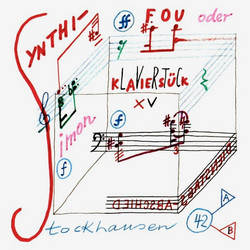
*2022 Stock.* Karlheinz Stockhausen – “Synthi-Fou / Dienstags-Abschied ” "A double –CD like this one falls right into that crystal clarity, giving yet more insight into how his art is achieved, piece by piece, structurally – but as it is with human beings or a flower or an Earth sun rise, the result is much more and something else altogether than the sum of all the parts… and somewhere in that realm lies the real mystery; that elusive, vibrant core of beauty and truth which can’t be accounted fo…
Oktophonie
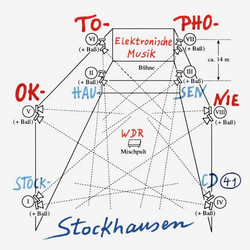
*2022 Stock.* Karlheinz Stockhausen – “Oktophonie ” Realized at the Studio für Elektronische Musik, WDR, August 23 - November 30, 1990 & Aug. 5-30, 1991. " (...) Stockhausen also points out that the production and spatialization are described in the separate OCTOPHONY score. This score is indeed a very meticulous and detailed one, indispensable for aficionados who will want to enter the inner workings of the OCTOPHONY structure. It is an extreme score in this aspect, in the minute details of its…
Donnerstag Aus Licht
Karlheinz Stockhausen – “Donnerstag aus Licht” (“Thursday from Light”); opera in three acts, a greeting and a farewell for 15 musical interpreters (4 solo voices, 8 instrumental soloists, 3 solo dancers), chorus, orchestra and magnetic tapes (1978 – 1980) " It arises in a silvery, calm motion of wind instruments – obviously preparing us for something of importance and vast durations. It is “Donnerstag-Gruss” (“Thursday Greeting”); the start of “Donnerstag aus Licht” (“Thursday from Light”); the …
Sirius
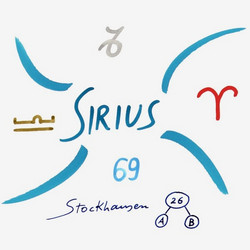
*2022 Stock.* Karlheinz Stockhausen – “Sirius” eight-channel electronic music and trumpet, soprano, bass clarinet, and bass is a music-theatre composition by Karlheinz Stockhausen, composed between 1975 and 1977. "It begins with a slowly emerging hum - like a disturbance in the wiring of your sound equipment -; then evolves into a murmur of great timbral depths, finally releasing itself into a spinning, swooshing, disturbing sound of higher frequencies in the foreground, panning between the spea…
Tierkreis / Musik Im Bauch
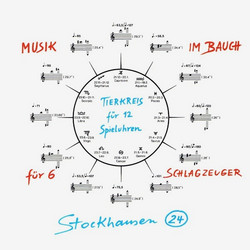
*2022 Stock.* Karlheinz Stockhausen – “Musik im Bauch (Music in the Belly) ” is a piece of scenic music for six percussionists and music boxes composed by Karlheinz Stockhausen in 1975. "The origin of “Musik im Bauch” and “Tierkreis”, as far as can be traced, goes back to 1967, when Stockhausen’s daughter Julika was around two years old. Stockhausen explains that all kinds of minute sounds were coming from the little girl’s insides, and Stockhausen joked with her and said: “Julika, you really ha…
Mantra
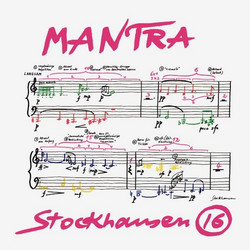
*2022 Stock.* Karlheinz Stockhausen – “Mantra” was composed in 1970 and premiered in autumn of the same year at the Donaueschingen Festival. The work is scored for two ring-modulated pianos; each player is also equipped with a chromatic set of crotales (antique cymbals) and a wood block, and one player is equipped with a short-wave radio producing morse code or a magnetic tape recording of morse code. "The real basis for “Mantra” is a thirteen-note motif; formula, allotting each note specific ch…
Sold Out
Spiral - Pole
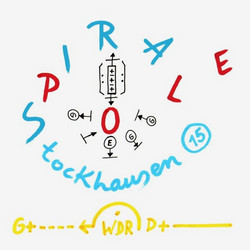
Karlheinz Stockhausen – “Kurzwellen” for six players (1968). Spiral for a soloist with a shortwave receiver together with Pole (Poles), for two performers with shortwave radio receivers and a sound projectionist, is one of a series of works dating from the 1960s which Stockhausen designated as "process" compositions. These works in effect separate the "form" from the "content" by presenting the performers with a series of transformation signs which are to be applied to material that may vary con…
Sold Out

Aus Den Sieben Tagen
Packaged in two Multiboxes, with a 124 page booklet (in English language), in a 2" thick slip box. Karlheinz Stockhausen – “Aus den sieben Tagen” for six players (1968) (From the Seven Days) is a collection of 15 text compositions by Karlheinz Stockhausen, composed in May 1968, in reaction to a personal crisis, and characterized as "Intuitive music"—music produced primarily from the intuition rather than the intellect of the performer(s).." This type of composition or instruction or whatever on…
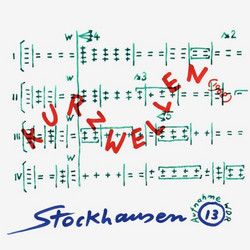
Kurzwellen
*2022 Stock.* Karlheinz Stockhausen – “Kurzwellen” for six players (1968). Participants: Aloys Kontarsky (piano & short-wave radio), Harald Bojé (electronium & short-wave radio), Alfred Alings & Rolf Gehlhaar (tam-tam & short-wave radio), Johannes G. Fritsch (electric viola & short-wave radio), Karlheinz Stockhausen (filters & potentiometers). Kurzwellen is one of a series of works dating from the 1960s which Stockhausen designated as "process" compositions. These works in effect separate the "f…
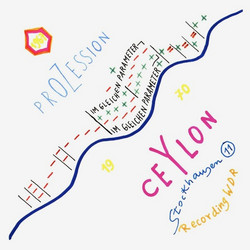
Prozession / Ceylon
Karlheinz Stockhausen – “Prozession” (1967) / “Ceylon” (1970) Prozession is one of a series of works dating from the 1960s which Stockhausen designated as "process" compositions. These works in effect separate the "form" from the "content" by presenting the performers with a series of transformation signs which are to be applied to material that may vary considerably from one performance to the next "Prozession is an ensemble piece that Stockhausen wrote for his ensemble of the time, but it is…
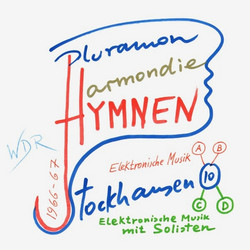
Hymnen
Program notes in German and English in 200-page booklet. Karlheinz Stockhausen personally mixed down and mastered these recordings from the original analogue tapes for this CD edition. Karlheinz Stockhausen –“Mikrophonie I” (1964) for tam-tam, 2 microphones, 2 filters with potentiometers (6 players) / “Mikrophonie II” (1965) for choir, Hammond organ, 4 ring modulators / “Telemusik” (1966) (electronic music). Together with Stockhausen's immediately preceding work Mixtur, for five orchestra grou…
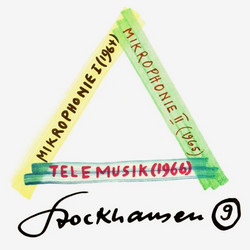
Mikrophonie I / Mikrophonie II / Telemusik
Packaged in a thick 2CD jewel case with 128-page booklet in English. Karlheinz Stockhausen –“Mikrophonie I” (1964) for tam-tam, 2 microphones, 2 filters with potentiometers (6 players) / “Mikrophonie II” (1965) for choir, Hammond organ, 4 ring modulators / “Telemusik” (1966) (electronic music). Together with Stockhausen's immediately preceding work Mixtur, for five orchestra groups, four sine-wave generators, four ring modulators, they form a tryptych of live-electronic works, where electronic …
Mixtur
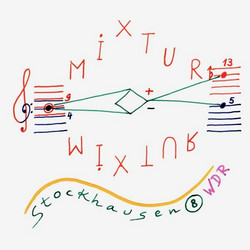
*2022 Stock.* In short, some of the most breathtaking, intrepidly advanced electronic music ever recorded. A truly precious survey of a lone, pioneering voice in electronic music. Cardboard slipcase housing a CD jewel with 104-page booklet in German and English. Karlheinz Stockhausen – “Mixtur” (1964) is one of the earliest compositions for orchestra with live electronics, and is amongst the first compositions using live-electronic techniques generally. "Orchestral sounds transform into electron…
Momente
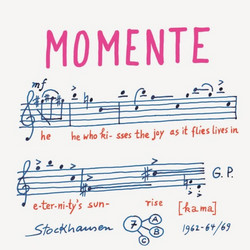
Momente (Moments), written between 1962 and 1969, was Stockhausen's first piece composed on principles of modular transposability, and his first musical form to be determined from categories of sensation or perception rather than by numerical units of musical terminology. Comes with a 72-page 4-color big size booklet in German and English, plus a separate 36-page 2-color book with complete sung texts. "Momente for soprano solo, four chorus groups and thirteen instrumentalists” is dominated by th…
Zyklus - Refrain - Kontakte
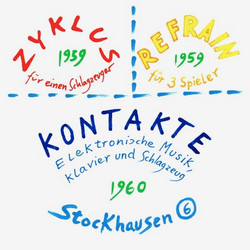
In short, some of the most breathtaking, intrepidly advanced electronic music ever recorded. A truly precious survey of a lone, pioneering voice in electronic music. Cardboard slipcase housing a CD jewel case and a 184-page booklet in German and English. Karlheinz Stockhausen – “Zyklus” (1959) / “Refrain” (1959) / “Kontakte” (1959 – 60). "Krakabang! Prrrrrrrrrr! Plipprrring! Swooossssh! Goooong! Wuawuawuawua! You’re in the middle of it right from the start, with nowhere to hide. Maybe that’s how…

Elektronische Musik 1952-1960
"Some of the most breathtaking, intrepidly advanced electronic music ever recorded" - five revolutionary masterpieces from WDR Studio 1952-1960. Stockhausen's systematic exploration from Etude Musique Concrète to monumental Kontakte established the foundation of electronic composition during the heroic age of studio experimentation.
A Rainbow in Curved Air - Tierkreis - Zodiac
An unexpected musical combination of two masterpieces of modern music rethought through the use of contemporary electronic instruments that marvels at lively and innovative sounds, in the version with keyboards and electronics presented at Terraforma Festival 2019.
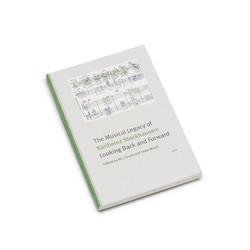
The Musical Legacy of Karlheinz Stockhausen: Looking Back and Forward
Karlheinz Stockhausen was one of the most influential and prolific composers of the twentieth century. His legacy extends far beyond his extensive catalogue of musical works to his achievements as a pioneer of electronic music, as a writer and thinker on music, and as a teacher. In this volume, various aspects of Stockhausen“s legacy are discussed, including his influence on the creative work of others, and the influences he likewise derived from some of his closest associates. Central theoretic…

Klang Bilder
**Hardcover edition**In the late 1950s, avant-garde musicians were exploring new ways of expressing their experimental compositions in writing. Searching for a universal language that would reach far beyond music, they no longer considered the traditional system of musical notation as sufficient. By progressing into electronic music, as well as by linking music and performance, they blurred the boundaries between different genres and inevitably changed the notation of music. Karlheinz Stockhause…
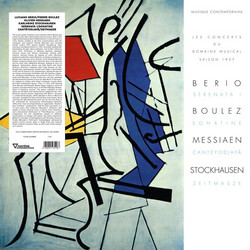
Serenata I/Sonatine/Canteyodjaya/Zeitmasze
**Edition of 500. 180 gram vinyl** Fantôme Phonographique present a reissue of Serenata I/Sonatine/Canteyodjaya/Zeitmasze, originally released in 1958. The avant-garde composer and conductor Pierre Boulez was a titan of post-war experimental classical music. Born in the small cheesemaking town of Montrbrison in central France in 1925, Boulez studied at the Paris Conservatoire with the composer and organist Charles Messiaen and received private tuition from pianist Andrée Vaurabourg; after moving…
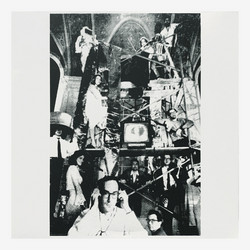
Originale
A recording of Stockhausen's Originale staged at Judson Hall, New York, in September 1964 by Charlotte Moorman, directed by Allan Kaprow, with Nam June Paik, James Tenney, Max Neuhaus, Alvin Lucier, Jackson Mac Low and Allen Ginsberg.
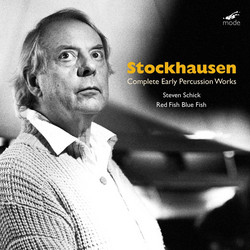
Complete Early Percussion Works
Karlheinz Stockhausen's early percussion works on two CDs: Zyklus, Kontakte for piano and percussion with tape, Mikrophonie for tam-tam, Refrain and Schlagtrio, with new transfers from the analog tapes.
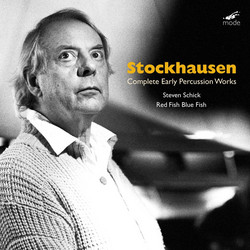
Complete Early Works for Percussion
Karlheinz Stockhausen's early percussion works on DVD-Audio with surround sound: Zyklus, Kontakte for piano and percussion with tape, Mikrophonie for tam-tam, Refrain and Schlagtrio, from new transfers of the analog tapes.

Beton-studie / Zeitmass Fur Funf Holzblaser
A collection of some of Karlheinz Stockhausen's earliest work, including his earliest piece of musique concrète "Beton-Studie" (aka "Étude") written by Stockhausen in 1952-53 at Pierre Schaeffer's studio at the RTF in Paris. Until 1992 this piece was believed to have been lost. The LP also includes the celebrated "Zeitmass" (1955), and "Klavierstück XI, parts I-IV" (1956), both of which helped to cement Stockhausen's role as one of the leading German composers of the 20th century
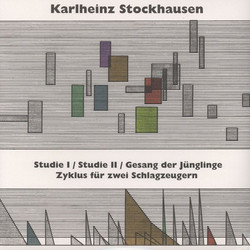
Studie I & II, Gesang Der Junglinge, Zyklus Fur Zwei Schlagzeuge
A collection of Stockhausen’ s most important works from the 1950s, particularly “Gesang der Jünglinge” (“Song of the Youths”) 1955-56, probably the most iconic piece of electronic music ever written. Only because of Stockhausen’s complete understanding of electronic equipment, along with his creative genius, was he able to produce this masterwork, the first piece of music to unify vocals and electronics.
Le Concerts du Domaine Musical 1956
Doxy presents a reissue of "Les Concerts du Domaine Musical", originally released by the French label Véga in 1956. Le Domaine Musical was a concert society established by Pierre Boulez in Paris, which was active from 1954 to 1973. Boulez intended to provide opportunities for new music, after a general musical migration from Germany and Austria to Paris in the wake of those countries' legacy of war-torn decades without music. Le Domaine Musical created an exciting milieu in which the best an…

For basset horn
Performed by Michele Marelli (basset horn): Traum-Formel (1981); Evas spiegel (1984); Susani (1984); Die 7 lieder der tage (1986); Freia (1991); In freundschaft (1977).

Sulla musica
Italian only - Se consideriamo le grandi personalità del Novecento, Stockhausen si distingue come una delle forze più creative nella musica contemporanea. Figura controversa e a tratti contraddittoria Stockhausen in queste pagine mostra di essere semplicemente inafferrabile nella vastità delle sue riflessioni e allo stesso tempo di una lampante chiarezza nella sua visione della musica e del mondo. Stockhausen ha investigato a fondo tutti gli aspetti del suono nelle sue composizioni e nella sua r…

Earle Brown Contemporary Sound Series Vol. 1
Few figures of the American avant-garde wore as many hats as Earle Brown. Composer, graphic notation pioneer, member of the New York School alongside John Cage, Morton Feldman, and Christian Wolff - but also, and crucially, a record producer whose ear shaped one of the most important document series in 20th century music. Between 1960 and 1973, working first for Time Records and then Mainstream Records, Brown curated the Contemporary Sound Series - 18 LPs presenting works by 49 composers from 16…
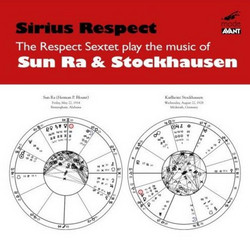
Sirius Respect
The Respect Sextet, a young New York jazz group, plays music by Sun Ra and Karlheinz Stockhausen, drawing comparisons between the two composers and asking how the idea of space shaped their work.

Spiral I & II, Pole, Wach, Japan, Zykus,
amazing (an cheap) double CD set featuring most of the Stockhausen "intuitive music" (ie quasi improvised). The first piece is Zyklus for solo percussion performed here by Tristan Fry in 1974. Zyklus was one of the first works with a graphic score allowing the performer some freedom to improvise. In the late 60s Stockhausen developed the idea of scores which determined a process rather than the exact content & his group toured the world playing this music. Several pieces are included her…
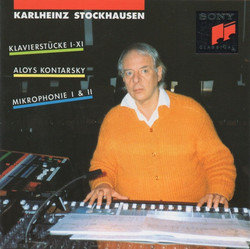
Klavierstücke I-XI / Mikrophonie I & II
Beautiful double CD set, containing a mindblowing Mikrophonie version... Mikrophonie is the title given by Karlheinz Stockhausen to two of his compositions, written in 1964 and 1965, in which “normally inaudible vibrations . . . are made audible by an active process of sound detection (comparable to the auscultation of a body by a physician); the microphone is used actively as a musical instrument, in contrast to its former passive function of reproducing sounds as faithfully as possible” (Stock…
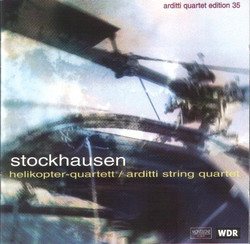
Helikopter-Quartett
The Helikopter-Streichquartett (Helicopter String Quartet) is one of Karlheinz Stockhausen's best-known pieces, and one of the most complex to perform. It involves a string quartet, four helicopters with pilots, as well as audio and video equipment and technicians. It was first performed and recorded in 1996. Although performable as a self-sufficient piece, it also forms the third scene of the opera Mittwoch aus Licht ("Wednesday from Licht"). The Helicopter Quartet was originally commissioned b…

Harlekin
Karlheinz Stockhausen's 'Harlekin' ('Harlequin') for clarinet; and 'Der Kleine Harlekin' ('The Little Harlequin') for clarinet (performed here by Suzanne Stephens). Only one copy available.
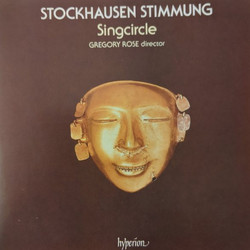
Stimmung (Singcircle Version)
In each section a new overtone melody or 'model' is introduced and repeated several times. Each female voice leads a new section eight times, and each male voice, nine times. Some of the other singers gradually have to transform their own material until they have come into 'identity' with the lead singer of the section by adopting the same tempo, rhythm and dynamics. When the lead singer feels that 'identity' has been reached, he or she makes a gesture to another singer who leads the next sectio…