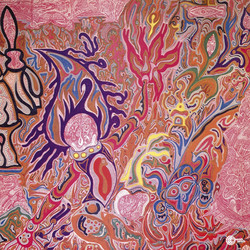
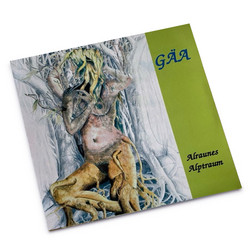
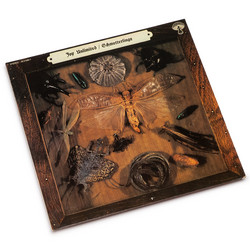
With deluxe four-page insert. Limited to 1000 hand numbered Picture Discs. Top sound quality. Nobody liked it at the time. Alfred Kersten, owner of the Kerston label, had discovered Gäa at one of their early gigs in the Saarland and promised them a record. By the time the band arrived at his Stuttgart studio in the summer of 1973 - with almost no money, camping in tents outside the building for days until Kersten relented - his enthusiasm had curdled into obligation. The sessions were rushed. No one was satisfied. The LP, Auf Der Bahn Zum Uranus, was pressed in 300 copies and more or less abandoned by its own label. The band felt the same. What neither the label nor the band could have anticipated was the life the record would go on to lead without them.
Gäa came from Saarland, the thin wedge of Germany pressed between France and Luxembourg - a region whose cultural identity has always sat at an oblique angle to the rest of the country. Named after the ancient Greek earth goddess (Gaia in Latin notation), the quintet of Werner Frey, Werner Jungmann, Günter Lackes, Peter Bell and Stefan Dörr inhabited the earthier, more telluric end of the krautrock spectrum. Unlike many of their contemporaries, they sang entirely in German - a small but pointed decision that grounded the record in something local and specific, resistant to the internationalism that was pulling much of the scene toward English.
The album opens with "Uranus," nine and a half minutes that begin as a spoken overture over near-silent guitar before erupting into a melancholy wall of organ, fuzz guitar and layered vocals. The organ, handled by Lackes, is the record's governing element throughout - warm and slightly distorted, closer to the heavy end of Pink Floyd's Meddle than to the drier kosmische of the Berlin school. "Bossa Rustical" pivots entirely, a compact piece with an almost pastoral lightness, before "Tanz Mit Dem Mond" extends across seven minutes of hypnotic cycling that holds some of the most genuinely beautiful guitar work on the record. Side two moves through "Mutter Erde" and "Welt Im Dunkel" toward the closing title track, a seven-and-a-half-minute piece that functions as both summary and dissolution - the album slowly folding back into itself, fading rather than concluding.