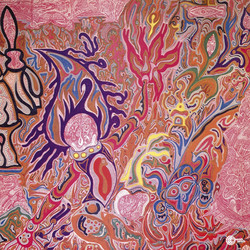
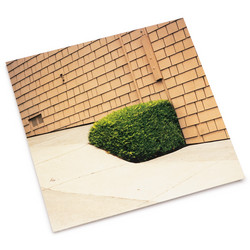
What you hold is half a record. Three tracks, twenty minutes, one side of an intended LP that never found its other half. Gäa recorded these sessions at Leico Studio in 1975, then ran out of money before the album could be finished. By 1978, the band had dissolved. The title, Alraunes Alptraum - Alraune's Nightmare - reaches into German earth mythology: the Alraune, or mandrake root, is an earth spirit pulled unwillingly from the ground. The name mirrors that of the band itself, named after Gaia, the ancient Greek goddess of earth. A fitting symbol for music that was never quite fully uprooted into the world.
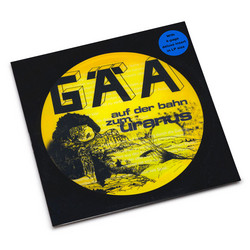
The story behind even arriving at these sessions is remarkable. Helmut Heisel, Stefan Dörr, Werner Frey and Günter Lackes had formed in the Saarland, the thin strip of Germany wedged between France and Luxembourg, in 1973. Signed in a moment of enthusiasm by Alfred Kersten of the Kerston label, they arrived at his Stuttgart studio to find the label owner's interest had evaporated. The band camped in tents outside for days until Kersten, unable to withdraw entirely, let them in to record in a hurry. The resulting LP, Auf Der Bahn Zum Uranus, was pressed in 300 copies, dismissed by its own label, and left to accumulate myth on its own terms - which it duly did, eventually trading at over 600 euros on the secondary market.
The 1975 sessions captured here are a different proposition: better conditions, a cleaner sound, a band that had shed personnel and tightened around a core of four. "Autobahn" opens with a rolling, organ-driven groove that trades the cosmic looseness of the debut for something harder and more anchored. "Heilende Sonne" is compact and direct. "Morgendämmerung" - Dawn - stretches across nearly ten minutes of instrumental drift, Lackes's keyboards pushing through registers that recall the more terrestrial moments of Pink Floyd's Meddle, or the organ-heavy end of Mythos, without resembling either precisely. All three are sung in German, which in the krautrock landscape of 1975 carried its own small statement of local intent.
Garden of Delights' vinyl edition presents this material on LP for the first time, supplemented by rehearsal recordings from the mid-1980s when former members reconvened informally - a coda that completes the picture without pretending to replace what was lost. A document of productive incompletion, and a necessary companion to one of the most quietly influential records the Kerston label ever released.