Dee Brown's Bury My Heart at Wounded Knee, published in 1970, was the first major history of the American West written from the perspective of its Native peoples. Its impact across Europe was considerable - a generation reading it not as distant history but as a mirror turned on the mechanisms of power still very much in operation. In Germany, where the mythology of the American frontier had deep and complicated roots, it landed with particular force. Wolf Conrad "Conny" Veit read it, and made a record.
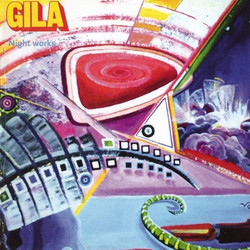
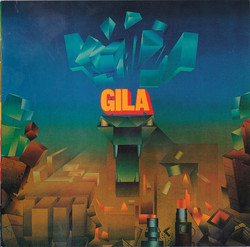
By 1973, Veit had already dissolved the original Gila - a Stuttgart commune-dwelling psychedelic outfit whose 1971 debut, Free Electric Sound, stands among the most vivid documents of early krautrock - and moved to Munich, where he found himself absorbed into the orbit of Florian Fricke's Popol Vuh. He played guitar on Hosianna Mantra and Seligpreisung, those hushed, sacred records that were pulling Fricke steadily toward a music of stripped light and devotional stillness. Through Fricke's world he encountered Daniel Fichelscher, percussionist and multi-instrumentalist in Amon Düül II, whose communal home in Kronwinkel he frequented. The decision to revive Gila was in some ways a pretext: Veit, Fricke, Fichelscher, and Veit's partner Sabine Merbach on vocals entered Dieter Dierks' Studio in Stommeln and recorded an album that belonged to none of their existing projects and to all of them simultaneously.
The result occupies territory that no one else was mapping in 1973. Three of its seven tracks incorporate Native American texts translated into English - "In a Sacred Manner," "Sundance Chant," "Black Kettle's Ballad" - while the remainder are Veit compositions that carry the same gravity, the same quality of mourning held in open space. The 12-string acoustic guitar is the record's spine, multi-tracked into shimmering, baroque webs that catch and refract Merbach's voice - something between a folk singer and a celebrant - and Fricke's piano and mellotron, which arrive not as texture but as light from another room. "The Buffalo Are Coming" closes the album in a slow swell that contains the whole of its argument without stating it.
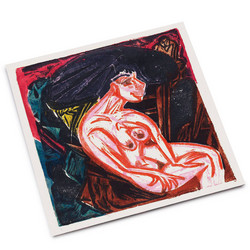
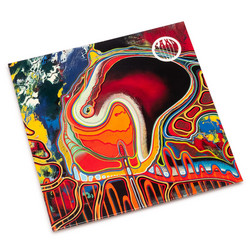
This is not the Gila of Free Electric Sound, nor quite the Popol Vuh that was crystallizing in parallel. It is a one-off, a document of a specific convergence at a specific moment - which is precisely what makes it irreplaceable. The original mastertapes are lost or destroyed; this Garden of Delights edition, transferred from the best available source and with the track order corrected for the first time on any reissue, is the definitive version.