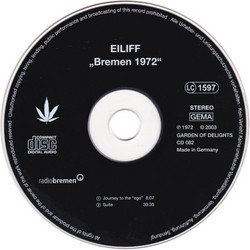
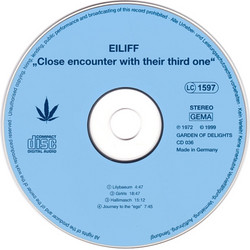
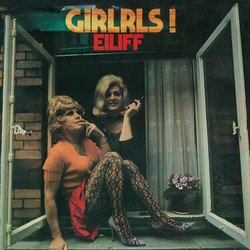
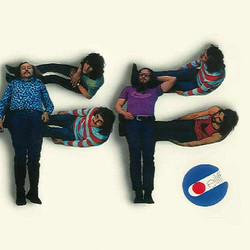
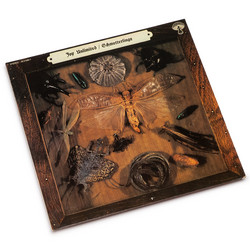
Limited and hand numbered edition of 1000 copies. With 20-page deluxe insert in LP size - Cologne, October 18, 1972. WDR is broadcasting live. The set lasts just under forty-seven minutes. Within a year, the band will be finished. Eiliff were formed in the late 1960s around pianist Rainer Brüninghaus - the same Brüninghaus who would spend the following three decades as one of ECM's most indispensable musicians, appearing on records by Jan Garbarek, Eberhard Weber (Colours), and Volker Kriegel. On guitar and sitar, Houschäng Nejadépour - Iranian-German, briefly a member of an early Kraftwerk lineup, and later the force behind Guru Guru's Dance of the Flames - brings a playing style that Michael Rother once described as the finest Hendrix interpretation in Düsseldorf, before insisting it was entirely something else. Herbert Kalveram on saxophone, Bill Brown on bass, Detlev Landmann on drums. Two albums on Philips, both mostly overlooked. Then this broadcast, and then nothing.
What the WDR microphones captured that night sits at a peculiar intersection. The Canterbury influence is audible - Brüninghaus's Hammond has the same lateral, probing quality as Soft Machine at their most tightly wound - but the improvisational logic is harder and more physical, closer to the American jazz-rock fringe than to anything emerging from the continent at the time. "Girlrls," at nearly nineteen minutes, builds through layers of rhythmic pressure that never fully resolve, Kalveram's saxophone finding spaces between Nejadépour's guitar lines rather than trading solos in any conventional sense. "Hallimasch" pivots into something looser and bluesier, vocal interventions surfacing and dissolving without explanation. The four-minute "Lilybaeum" that opens the set is almost a provocation in brevity - Brüninghaus alone, stacking organ tones into something close to a fanfare - before "Journey to the Ego" closes out with the kind of controlled release that suggests a band playing with full knowledge of its own powers.
It is, in other words, the document of a band at its peak and on the verge of dispersal. Garden of Delights' vinyl edition - the first time these recordings have appeared on LP - makes that moment available to a new generation of listeners. Essential for anyone serious about the German underground.