Shuoxin Tan, Natalia Molina Bohórquez
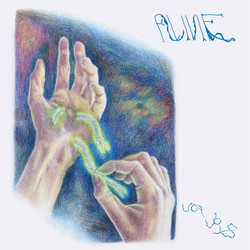
Durch Den Vorhang Gehen = 穿过屏风 (Tape)
The term ‘acousmatics’ refers to the tradition which tells us that the Greek philosopher Pythagoras gave his lectures from behind a curtain, whereby visual information was withdrawn off the screen and the audience could concentrate on listening. Listening to acousmatic music is not a static process as if the listener is aware of something hidden behind such a curtain. In the case of acousmatics, the sonic events reverberate through the curtain, beyond where they actually are produced, meeting up in the listener’s inner ear and the space the listener is in. So the questions arise: How real is what the listener hears? To what extent could what is heard be (un)consciously perceived by the listener? If we take an instrument as a primitive body, are there other ways of resonating through this body? How does the performer’s physical movement influence the sound?
Tracks a2, b1, and b3 are the recordings of their live improvisations, without any predetermined framework or instruction. The listener cannot precisely define the sound sources or the means of sound generation, but finds themselves in another reality relative to their own, on a dream voyage.
By juxtaposing these two different approaches the artists found the whole process fulfilling as a means to explore their own modes of communication through musical languages and instruments.
| A1 | Bisbigliando_23_Mär_2022_Take_1 | 02:36 | |
| A2 | Improvisation_23_Feb_2022_1. Teil | 14:30 | |
| A3 | Kombinationston_23_Mär_2022 | 03:22 | |
| B1 | Improvisation_24_Mär_2022 | 04:47 | |
| B2 | Bisbigliando_23_Mär_2022_Take_2 | 05:06 | |
| B3 | Improvisation_23_Feb_2022_2. Teil | 09:07 |
- Natalia Molina Bohórquez
- Composed By, Recorded By, Flute, Piccolo Flute [Piccolo], Performer [Body Movement]
- Shuoxin Tan
- Composed By, Recorded By, Computer [Laptop], Programmed By [Live Coding], Electronics [Live Electronics], Mixed By
- Jing He
- Cover
- Raphael Zöschinger
- Layout
- Zhu Wenbo
- Mastered By