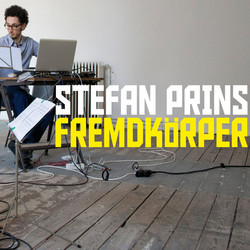
Inhabit presents Stefan Prins at a moment where his long-standing preoccupations with technology, mediation and fractured perception coalesce into one of his most immersive projects. Across the album, he treats composition less as the writing of “pieces” and more as the design of situations in which performers and electronics mutually infiltrate each other. Acoustic instruments, live processing, fixed media and often video or virtual presences interlock, creating an environment that the listener doesn’t simply observe but enters, as if stepping into a charged, flickering habitat.
The title is programmatic. To “inhabit” here means to dwell inside unstable systems: feedback networks between instrumental gesture and digital response, layered temporalities where live playing brushes against pre-recorded traces, and spaces in which the performers’ bodies are continuously reframed by technological extensions. Rather than treating electronics as a distant, abstract layer, Prins lets them wrap around the musicians, shadowing and distorting their actions in real time. You hear instruments doubled by synthetic avatars, fractured into glitches, stretched into spectral afterimages; you hear players learning to negotiate these avatars as partners and obstacles at once.
Throughout, Prins’ writing balances structural rigor with a highly physical, sometimes volatile surface. Rhythms often feel broken or stuttering, yet behind the apparent fragmentation lies a keen sense of dramaturgy: eruptions of noise give way to fragile, exposed lines; dense clusters suddenly freeze into static tableaux; hyperactive textures thin out until only a single, vulnerable sound remains. The music is frequently loud, gritty and confrontational, but it never lapses into chaos for its own sake. Each collapse and reassembly reveals a new facet of the environment, a different way in which humans and machines are co‑producing the space.
One of the striking aspects of Inhabit is how it foregrounds the performers as co-authors of that space. Prins’ scores demand not only virtuosity but a willingness to surrender some control to the systems in play. Musicians react to delays of their own actions, to distorted images and sounds of themselves, to algorithmic responses that can’t be fully predicted. That feedback loop becomes part of the drama: the music documents a process of adaptation, of bodies and ears slowly learning how to live inside a hybrid ecology. In this sense, the album doesn’t just depict a post-digital reality; it stages it in real time.
For listeners, Inhabit can feel like walking through a building whose walls rearrange themselves as you move. Familiar acoustic timbres - strings, winds, percussion, voice - keep reappearing, but their context is constantly shifting. Sometimes they function as anchor points amid electronic turbulence, sometimes they are swallowed by it, sometimes they trigger cascades that spiral beyond them. Prins exploits these shifts to question where the “piece” actually resides: in the written score, the software, the bodies onstage, the network that connects them, or the listener’s own act of tracing connections.
As a recorded object, Inhabit captures this complexity without flattening it. The production preserves a sense of spatial depth and directionality, letting the listener feel enveloped by the environment rather than placed at a safe, external distance. It’s an album that rewards close, repeated listening, as details that seemed incidental on first encounter - a faint mechanical whirr, a distant harmonic, a clipped breath – reveal themselves as structural threads in the larger weave.