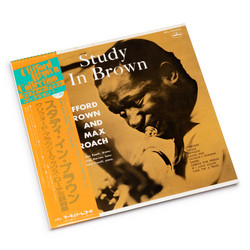
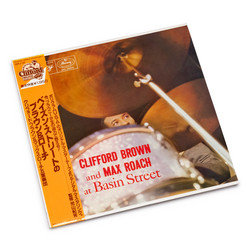
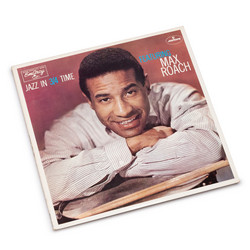
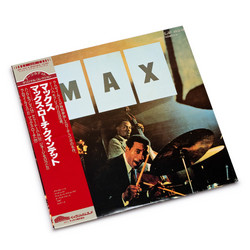
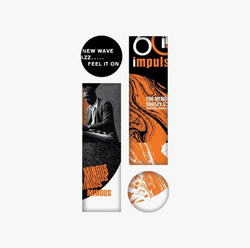
August 1961. Van Gelder Studio, Englewood Cliffs, New Jersey. Max Roach - the man who reinvented jazz drumming alongside Charlie Parker and Dizzy Gillespie in the 1940s, the co-leader with Clifford Brown of the definitive hard bop quintet until tragedy struck in 1956 - enters the studio with something to say. Something that cannot wait. Something that demands a new language.
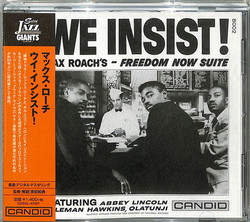
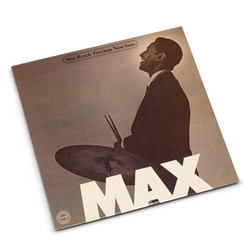
The year before, Roach had recorded We Insist! Freedom Now Suite for Candid Records, a searing response to the Civil Rights struggle that remains one of the most explicitly political statements in jazz history. Now, for the fledgling Impulse! label (catalog number A-8, one of the imprint's earliest releases), he pushes further - not only in message but in method. Percussion Bitter Sweet is the sound of hard bop straining at its seams, threatening to burst into something wilder. The harmonic frameworks bend and fracture. The soloists push toward abstraction. The triple percussion section - Roach's kit augmented by Afro-Cuban drums - creates polyrhythmic turbulence that dissolves any remaining attachment to conventional swing.
The frontline assembled for these sessions reads like a roll call of musicians poised between tradition and revolution. Booker Little on trumpet - just twenty-three years old, already recognized as a major voice, heir to Clifford Brown's throne but pushing toward something more angular, more dissonant, his intervals leaping where Brown's would glide. Eric Dolphy on alto saxophone, flute, and bass clarinet - the multi-instrumentalist whose partnership with Little at the Five Spot the previous month had pointed toward a new language entirely, his bass clarinet wails and alto shrieks slicing through the ensemble like premonitions of free jazz's imminent explosion. Julian Priester on trombone, Clifford Jordan on tenor saxophone, Mal Waldron at the piano with his insistent, almost obsessive comping, Art Davis on bass. And crucially, Carlos "Patato" Valdes on congas and Carlos "Totico" Eugenio on cowbell, their Afro-Cuban patterns colliding with Roach's bebop vocabulary to create something that belonged to neither world alone.
Then there is Abbey Lincoln. Roach's artistic and romantic partner, soon to become his wife, Lincoln brings her voice to two tracks - "Garvey's Ghost" and "Mendacity" - with a dramatic intensity that transcends conventional jazz singing. On the opener, her wordless vocals float above the 6/8 rhythms like a spirit summoning history, while on "Mendacity" her delivery veers toward theatrical declamation, raw and uncompromising.
What emerges is an album perpetually on the edge. The four-horn frontline creates dense, dissonant voicings that owe as much to the emerging avant-garde as to hard bop tradition. Dolphy's solos - particularly his bass clarinet excursions - inhabit a space where melody fragments into pure sound, where phrases refuse resolution. Little matches him with angular lines that seem to question the very chord changes beneath them. The absence of a fixed rhythmic center on several passages, with Roach and his percussionists engaging in free-form dialogue, anticipates the total liberation that Ornette Coleman and Cecil Taylor were simultaneously pursuing. This is not quite free jazz, but it is jazz straining toward freedom - the musical corollary to the political struggle the compositions address.
The six pieces form an unspoken suite. "Garvey's Ghost" pays tribute to the Black Nationalist leader Marcus Garvey, its 6/8 groove built on the triple percussion section that frees Roach to play with unprecedented responsiveness. "Mama" honors the Black women whose labor and love sustained generations. "Tender Warriors" salutes the young people carrying the struggle forward. "Praise For A Martyr" mourns those who fell - here the horns build collectively toward catharsis, individual voices merging into collective cry. "Mendacity" - with Lincoln's biting delivery - takes aim at hypocrisy and lies. "Man From South Africa," in Roach's own words, expresses "the anxiety, frustration, and conflict involved in the struggle for independence by the indigenous South African man" - and that anxiety translates into some of the album's most harmonically adventurous passages.
Less than two months after these sessions concluded, Booker Little was dead. Uremia claimed him on October 5, 1961 - he was twenty-three years old. Percussion Bitter Sweet stands as his penultimate recording, a testament to what might have been. The partnership between Little and Dolphy, so briefly documented at the Five Spot and across a handful of studio sessions, suggested a new direction for jazz as radical as anything Parker and Gillespie had unveiled two decades earlier. Critics have compared their telepathic interplay to Bird and Dizzy themselves - two young musicians searching for new ways to extend the language. That promise died in a New York hospital room.
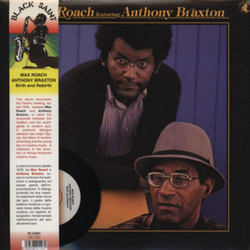
But the music remains - restless, searching, refusing easy answers. Roach, born in rural North Carolina in 1924, raised in Brooklyn, would continue exploring the outer edges for decades: M'Boom, his all-percussion ensemble founded in 1970; his duets with Cecil Taylor and Anthony Braxton in the 1980s. He died in 2007, leaving behind a body of work that redefined what drums could mean.
Percussion Bitter Sweet captures a moment of transition - personal and political, musical and historical. Hard bop dissolving into something freer. America confronting its contradictions. Artists refusing to separate aesthetic innovation from social commitment. The result is an album that sounds, six decades later, like it could have been recorded tomorrow.