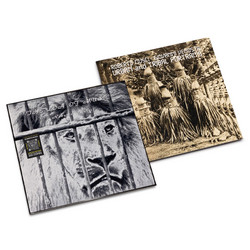
Jon Hassell, Brian Eno
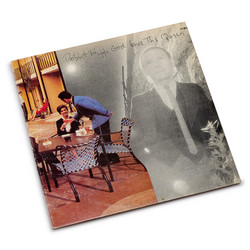
Possible Musics (LP)
condition (record/cover): NM / VG+ (light ring wear)
Fourth World Vol. 1: Possible Musics (1980) is the album that launched Jon Hassell's career as the inventor of what he termed the Fourth World: a vocabulary that fused North African and Indian classical rhythmic structures, La Monte Young-derived overtone work, and Brian Eno's ambient processing into a coherent third-position aesthetic, neither traditional nor avant-garde, neither Western nor non-Western. Hassell had studied with Pandit Pran Nath and Karlheinz Stockhausen, played in Terry Riley's first recording of In C, and developed his harmonized trumpet technique (using a pitch-shifter to produce raga-like microtonal lines) across the 1970s.
Eno's role on Possible Musics is that of a sympathetic producer rather than an equal collaborator. The five pieces are Hassell's, with Eno providing what he called "treatments". "Chemistry" opens with Hassell's trumpet over a tape-loop bed and percussion by Aiyb Dieng, Naná Vasconcelos and others. "Delta Rain Dream" sets a slow ritualised melody against thunderstorms of digital effects. "Charm" pulls a Pygmy-vocal-derived hocketing rhythm into the mix. The cumulative effect is hypnotic, deeply listening-rewarding, and unlike any record before it.
The original vintage Editions EG / Polydor pressing of 2335 207. Possible Musics would be followed by Dream Theory In Malaya (the Fourth World Vol. 2) the next year, and by Hassell's work with David Sylvian, David Byrne and many others. A central document of the Fourth World tradition and a pivotal record in the long aftermath of minimalism.