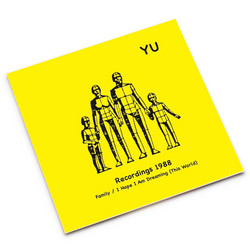
Recordings 1982–1987 gathers the core of YU’s original cassette output, tracing how three bored, depressed guys in Austin turned the early‑80s “do it yourself” charge into a long‑running thought experiment about survival. When the punk ethic hit Texas, Dwaine and David Woodliff and their friend Gaylon didn’t chase club slots or label deals; they bought a Teac, later a Fostex, set up Home Productions as their own imprint, and started committing songs to tape in whatever time and space life allowed. We Are YU, their first cassette from 1982, was the opening salvo: a home‑dubbed manifesto that introduced their blend of brittle post‑punk, skewed pop and spoken/sung monologues about the ways people stagger through existence. As the decade wore on they kept recording, upgrading machines but not abandoning the intimate, slightly claustrophobic sound of the room.
Most of the material on this 2LP was tracked on those Teac and Fostex decks, with YU also extending their reach via videos made at the local community access station and cassettes mailed to fanzines. Discovering Option Magazine proved pivotal: they sent in We Are YUand, in 1985, followed it with their second tape, Illusion of Control, which earned a favourable review from Tom Furgas in the December 1985 issue. Between 1986 and 1988 four more tapes appeared, each pushing their bedroom aesthetic and conceptual scope a little further. By the late ’80s family obligations pulled the members away and YU faded into private life, resurfacing only in 2009 when Dwaine was persuaded to upload the old community‑access videos to YouTube, prompting a small wave of rediscovery that would eventually lead to this archival edition.
At the heart of the set is the run of four concept‑driven cassettes whose original 1987 promo text sounded, to Vinyl‑On‑Demand, so “right and fresh” that the label chose essentially to reproduce it for this release. YU, as they framed it, began as “an idea of how to deal with the problem of living.” Boredom and depression were the initial fuel; music was the coping strategy. Across five tapes (1982–1988), they used jagged synths, drum machines, scratchy guitars and flatly delivered vocals to probe the ways people try to stay afloat: religion, neurosis, suicide, sex, philosophy, everyday absurdity. We Are YU focuses on the many strategies people adopt to deal with life’s pressure. Tracks like “Jerry F.” and “Boogie Man” take on religion; “I’ve Got This Fear” drags neurosis into the open; “Sometimes I Feel” stares down suicidal ideation; “We Are YU” and “Shoes” zoom out to the plain weirdness of “being human.” The songs are short, hooky and unnervingly direct, the kind of tunes that sound almost throwaway until the lyrics land a beat late.
Illusion of Control, their second cassette, dives deeper into how individuals and societies hold themselves together. The title concept splits in two. On one side, each of us cultivates an illusion of control so others will believe we are managing our behaviour; that shared pretence is what makes social life possible. Those who can’t sustain it - criminals, the mentally ill, anyone who leaks too much inner chaos - tend to be locked away, ignored or erased. On the other side, YU target leaders of all stripes: people invest them with the illusion of control and then follow that belief, often blindly. The band’s point is stark: the only actual control anyone has over us is whatever we agree to cede. The music mirrors these ideas with rhythms that feel steady until an extra bar appears, melodies that loop back on themselves, and lyrics that sound like late‑night arguments with the TV still on.