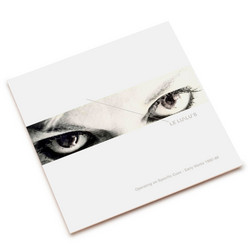
Sad Songs documents the moment Scott Alexander breaks from the gravitational pull of American Music Club and tests what happens when the band disappears but the songs don’t. Having grown tired of group dynamics and hungry for something “more modern,” he turned toward solo electronics, swapping rehearsal rooms for a small rig of synths, drum machines and tape. The resulting recording bears the imprint of the music he was obsessing over at the time - Brian Eno’s atmospheres, OMD’s melodic precision, Suicide and DAF’s stripped‑to‑the‑nerve pulse, Soft Cell and New Order’s bittersweet synth‑pop - but none of it lands as pastiche. Instead, those references become a set of coordinates he bends into his own off‑centre orbit.
At its core, Sad Songs is a synth‑pop tape, but one haunted by feedback halos and narcotic drift more commonly associated with Spacemen 3 or The Jesus and Mary Chain. Drum machines tick and snap with post‑punk economy, bass sequences stalk in minor keys, and Alexander’s vocals move between cool detachment and raw confession. Over that frame he pours a distinctive psychedelic haze: organ tones that smear at the edges, guitars that arrive as sheets of noise rather than riffs, reverbs pushed to the point where they feel less like effects than like extra rooms opening inside the mix. The songs keep their pop skeletons - verses, choruses, ear‑worm motifs - yet the flesh is blurred, as if each track were half‑remembered from a late‑night radio broadcast that never quite tuned in properly.
The recording grew out of a small but vivid electronic community in 1980s San Francisco, one that often gravitated more toward galleries and performance spaces than conventional rock venues. Alexander’s circle included artists from Voice Farm, Factrix, Naut Humon’s Rhythm & Noise and Tim North’s HoverDrum project, as well as their work on the industrial soundscapes for Survival Research Laboratories. That ecosystem left its mark on Sad Songs: beneath the synth‑pop surface you can hear an awareness of noise, installation and durational listening, an intuition that songs can be both discrete pieces and components in a larger, more cinematic continuum. It is music that would make sense blasting in a club, but also seeping from speakers in a darkened room full of flickering monitors and metal sculptures.