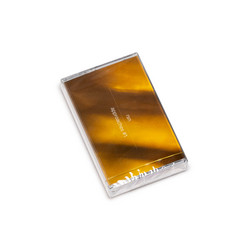
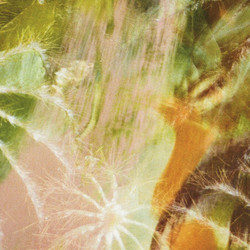
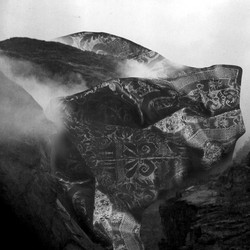
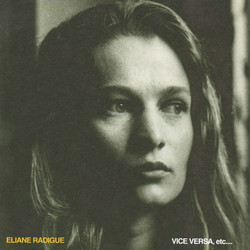
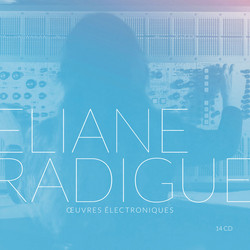
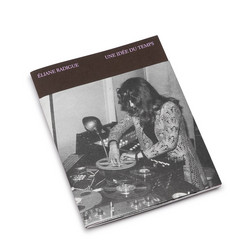
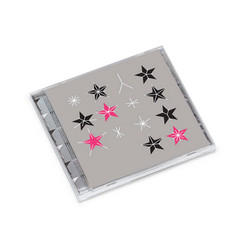
The first piece Eliane Radigue ever composed on a modular synthesizer, Chry-ptus was realised in 1971 on a Buchla 100 - the same one Morton Subotnick had recently installed at New York University. Conceived as two simultaneous tapes intended to be played together with or without synchronisation, the work produces, on each new realisation, a different play of sub-harmonics and overtones, slight shifts in amplitude and location altering the surface while leaving the underlying structure intact. Three variations were performed at the New York Cultural Center that same year, on the occasion of Radigue's first concert in the city, 6 April 1971, alongside a text by the painter Paul Jenkins, whose watercolour also adorns the cover.
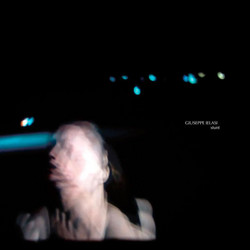
The 2007 Schoolmap edition gathers the original 1971 recordings of Chry-ptus I and Chry-ptus II across two CDs, alongside two later realisations - a 2001 version made by Radigue with Stefano Bassanese at CCMIX in Paris, and a 2006 version performed by Giuseppe Ielasi in Milano. Each track can be played alongside any of the others, and the result is a small architecture of permutations, every listening a slightly different room within the same building.
Before the long ARP 2500 works on which her reputation now largely rests, this was where it began. Radigue alone with a Buchla, working with the patience of a chemist - she would later describe spending the first months simply eliminating everything she did not want, keeping a notebook in which she tried to develop a notational system resembling chemical formulae. Issued in an edition of 1000 copies. A foundational document.