1
2
3
I have long pondered the concept of connectedness in relation to life’s existence. The Dalai Lama teaches that destruction of one’s neighbour equates to destruction of oneself. In contrast, modern Western culture has placed the individual at the epicentre of existence – to the detriment of non-humans and humans alike. Ecological Memory influences present or future responses of a community; it is this shared memory that enables organisms, objects and the environment to connect to each other, and to the other. What happens when a community or ecological system loses this memory, this connection? The systems begin to break down; intergenerational memory evolves in rapid short steps, culture and connection becomes unrecognisable. Time speeds up.
Yet with the naked eye, the universe reflects slow time. Its very distance provides a sense of stasis. Understanding the night sky could very well be the vastness of time we have forgotten through our ecological memory, our loss of the visible difference between the likes of night and day; non-referenceable and dictated by intangible rhythms that exist beyond the cyclic elements of nature.
Through Parasymbiosis I imagined sounds of the inherent connection between the earth and the universe. Contemporary society has rendered invisible the heritage of the night sky and what it teaches us. The wonder and awe it inspires, in its pure, unadulterated form untouched by light pollution and modern satellite activity, has always informed non-human and human life cycles and human culture. In modern times, only 40% of human beings can still see the Milky Way. We have forgotten that the dark sky and the earth reflect each other – they are, as a metaphor, parasymbiotic.
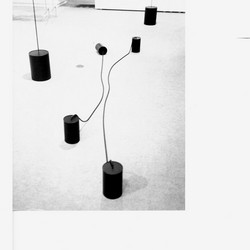
The Electric Cristal (EC) features strongly in Parasymbiosis. It is a microtonal, electro-acoustic instrument that has captured my imagination through its deep and fragile resonance created by touching glass rods encased in aluminium. Ceated by Dylan Crismani (AUS) in 2019, the EC conjures vast soundscapes. Electronics exploit the volatile vibrations and random frequencies that the instrument generates.
Yet with the naked eye, the universe reflects slow time. Its very distance provides a sense of stasis. Understanding the night sky could very well be the vastness of time we have forgotten through our ecological memory, our loss of the visible difference between the likes of night and day; non-referenceable and dictated by intangible rhythms that exist beyond the cyclic elements of nature.
Through Parasymbiosis I imagined sounds of the inherent connection between the earth and the universe. Contemporary society has rendered invisible the heritage of the night sky and what it teaches us. The wonder and awe it inspires, in its pure, unadulterated form untouched by light pollution and modern satellite activity, has always informed non-human and human life cycles and human culture. In modern times, only 40% of human beings can still see the Milky Way. We have forgotten that the dark sky and the earth reflect each other – they are, as a metaphor, parasymbiotic.
The Electric Cristal (EC) features strongly in Parasymbiosis. It is a microtonal, electro-acoustic instrument that has captured my imagination through its deep and fragile resonance created by touching glass rods encased in aluminium. Ceated by Dylan Crismani (AUS) in 2019, the EC conjures vast soundscapes. Electronics exploit the volatile vibrations and random frequencies that the instrument generates.
Details