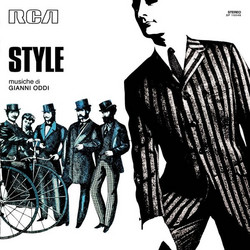
Bomb! Rhodes and Hammond, wah-wah guitar, strings, horns and the first traces of the synthesizer, moving between jazz-funk, bossa, psychedelia and pop with the ease that only the Roman studio scene of the mid-1970s could produce. Recorded in Rome in 1974 for RCA Italiana's short-lived library series and pressed in a tiny run for film, television and advertising producers rather than for sale, Gianni Oddi's Style has been one of the most sought-after titles in Italian library music for decades, and one of the best: eleven pieces by the saxophonist who, within a year of these sessions, would become Ennio Morricone's principal soloist. Schema returns it to circulation, remastered from the original master tapes.
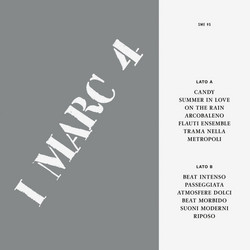
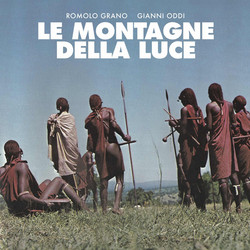
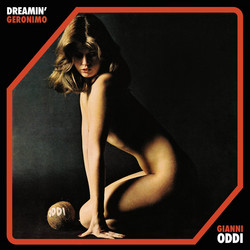
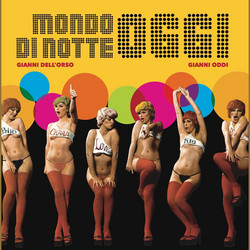
Gianni Oddi belongs to the generation of Roman session musicians whose names rarely made it onto the front of a sleeve but whose playing defined the sound of Italian cinema and television through the 1960s and 70s. A saxophonist with a background in jazz and ensemble work, he spent the early 1970s between RCA Italiana's studio productions and a handful of records under his own name - 3 and 4, both issued by RCA in 1974 - as well as collaborations with Romolo Grano (Le Montagne della Luce) and Gianni Dell'Orso (Mondo di Notte Oggi). Style, recorded the same year, was the last album to appear under his leadership. Shortly afterwards Morricone took him on as his principal saxophone soloist, a role he would hold for many years and across a great many scores. It is the last record on which Oddi is fully in charge of the material, made just before his career became bound up with Morricone's.
Most Italian library music came from specialist labels - CAM, Cinevox, Leonardi, Sermi and their offshoots - whose whole business was leasing music to producers. RCA Italiana was a different case. For a few years in the first half of the 1970s the major ran its own sonorizzazione series under the RCA Original Cast banner, with SP catalogue numbers, pressed in very small quantities and sent directly to production houses. These were working tools, not records for sale. Style came out in that series as SP 10048 and vanished almost as soon as it was pressed. The trade-off, as so often in library music, was freedom: with no single to deliver and no market to second-guess, Oddi could walk into the studio with a group of first-rate players and record what interested him.
The first side sets out the album's range straight away. Moda d'Estate opens as an unhurried Euro-bossa, reverbed harpsichord over percolating berimbau and loose guitar. Popoff changes gear completely: heavy wah-wah guitar, distorted bass and conga-driven funk, a tight horn section riding over a Rhodes that never stops moving - the title shared, whether by design or coincidence, with the Radio RAI programme that from 1973 became one of Italy's main windows onto new international music. Notte a Bagdad weaves cellos, violins, winds and double bass around careening tablas before Oddi steps forward with a saxophone solo that heads well outside the changes; Fine di un Amore is lithe bossa jazz, luminous strings, spacey Rhodes and brushed percussion; Torte in Faccia tips into pop-psych ragtime, harpsichord, toy piano and synthesizer stacked over a snapping snare. The second side opens with Chanel N. 7, a slow, atmospheric jazz piece built on the interplay of flute, electric piano and vibraphone, before Una Giornata a Rio lets loose a fiery psychedelic samba, answered by the jazz-funk of Kimono Pop, the catwalk swagger of Sfilata all'Hilton and the brooding closer Omertà.
What holds it all together is arrangement. Funk supplies the groove, jazz the harmonic freedom, psychedelia the texture and pop the melodic directness, but at no point does the record feel like a checklist of styles. The playing is relaxed and precise in the way that only working session musicians can manage, and the recording has the depth and warmth that made the Roman studios of the period so distinctive. It is easy to file Style alongside the work of Piero Umiliani, Alessandro Alessandroni and the other composers who moved freely between cinema, television and the studio in those years, and it sits comfortably in that company, but it also holds up as an album in its own right rather than a set of cues. Fifty years on, it has lost none of its immediacy. A must for anyone following the thread of Italian soundtrack and library music, and impossible to recommend enough.