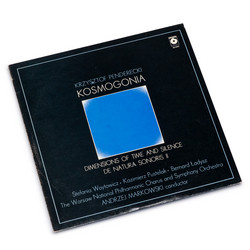
Karlheinz Stockhausen, Krzysztof Penderecki, Earle Brown, Henri PousseurFeaturing: Bruno Maderna
The New Music (LP)
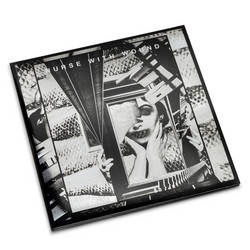
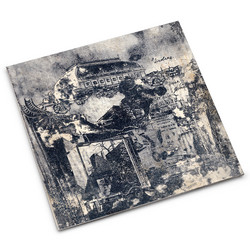
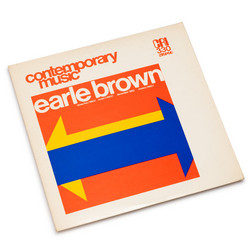
condition (record/cover): EX / VG (discoloration lines on front and general wear) - This album includes the best performance that Stockhausen's Kontrapunkte has ever had: the fact that Maderna's pianist was Rzewski no doubt contributed to its excellence. One of the great introductory documents to the post-war avant-garde, and simultaneously a record that rewards deep familiarity. Bruno Maderna conducts members of the Rome Symphony Orchestra in four works that together map the terrain of new music circa 1960: Stockhausen's Kontra-Punkte (1952) for ten instruments, Penderecki's Threnody for the Victims of Hiroshima (1960) for fifty-two strings, Earle Brown's Available Forms I (1961) for chamber ensemble, and Henri Pousseur's Rimes pour différentes sources sonores for orchestra and tape. Four composers, four countries, four radically different responses to the question of what happens after the old forms break.
The programming alone would make this essential, but it is Maderna's conducting that makes it irreplaceable. The Italian composer-conductor (1920-1973) was unique among the post-war generation: a working composer of the first rank who was equally a working conductor of prodigious range and sympathy, the one musician trusted by everyone from Nono and Berio to Cage and Brown, from the Darmstadt inner circle to the orchestral world. His Kontra-Punkte is immaculate - Stockhausen's early masterpiece of thinning textures (ten instruments progressively reduce to solo piano) played with chamber music precision and genuine warmth, with Frederic Rzewski at the piano. His Threnody has a visceral impact that later, more polished recordings rarely match. His Earle Brown is utterly convincing - Available Forms I, with its open-form structure allowing the conductor to choose the order of events in real time, was the kind of work Maderna was born to conduct: his own music explored similar territory.
Pousseur's Rimes closes the disc with the most radical sound on it: orchestra combined with musique concrète tape, the two sources interpenetrating and commenting on each other. This was the first volume of a three-LP RCA Victrola series, The New Music, all conducted by Maderna in Rome; Volume 2 includes Boulez, Haubenstock-Ramati and Maderna's own music, Volume 3 has Nono, Berio, Fukushima and Lehmann. Together they constitute a major document of Maderna's advocacy and one of the most intelligently programmed surveys of the post-war avant-garde ever recorded. Liner notes by Massimo Mila, the great Italian music critic.
LP. RCA Victrola VICS-1239, 1967. First volume of The New Music series.