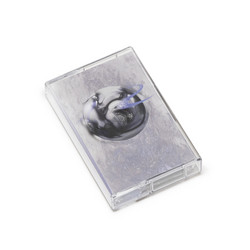
** 2026 Stock. Original 1986 Copies that may show some signs of long storage wear. ** Across his career, Rolf Enström has been less interested in occupying a genre than in testing how far music can stretch when it brushes against other arts. Known as a composer who “unceasingly seeks new artistic paths and new means of expression,” he has frequently braided his work with visual art and literature, using text, image, and performance as catalysts for sonic experimentation rather than decorative additions. TNT marks a bracing, concentrated pause in that outward expansion: on this record we encounter Enström stripped back to the studio, working in the domain of pure electroacoustic music, with no extra-artistic scaffolding to mediate or soften the impact.
The album gathers three works - Dagbrott, Sekvens i blått, and TNT - that together span eight years of compositional development, allowing the listener to hear how his approach to sound materials evolves while certain obsessions remain constant. The title Dagbrott (“open-pit mine”) hints at a practice of excavation: sound is quarried, fractured, and layered, as if Enström were cutting into a dense sonic terrain to expose strata of noise, resonance, and silence. Sekvens i blått suggests a different angle on the same urge, less about violent extraction and more about tint and contour, a sequence “in blue” that treats timbre and register like shades on a canvas rather than notes on a staff. By the time we arrive at TNT, the music feels like a volatile synthesis of these impulses - excavation and coloration, structure and rupture - compressed into a form where every gesture carries the risk of detonation.
What binds the three pieces is not narrative but a shared conviction that sound itself is the primary dramatic actor. Enström’s turn here to “pure electroacoustic music” does not mean abstraction for its own sake; instead it foregrounds the physicality of recorded sound - its grain, its weight, its capacity to suggest spaces, objects, and movements without ever naming them. Without the explicit presence of text or image, the listener becomes the site where these implied visuals and stories are assembled, drawing mental landscapes out of hums, bursts, and resonant voids. This places TNT in a compelling position within Enström’s oeuvre: it is at once an inward-looking laboratory, testing materials and techniques in isolation, and a hinge-point that clarifies why his later collaborations with visual and literary media feel so charged. The record shows that even when all external references are stripped away, his music remains resolutely theatrical - a drama of pressure, silence, and collision unfolding entirely in the ear.