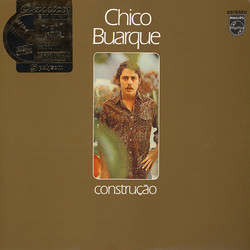
Chico Buarque
Vida (LP, Green Translucent Marbled)
Tracked express shipping from Italy, no customs or import VAT in the EU. Shipping costs
Vida finds Chico Buarque working with the deceptive lightness that has always been his sharpest tool, turning seemingly modest vignettes into songs that linger like novels read in a single sitting. The title - “Life” - is as broad as it gets, yet the record approaches it sideways, through small gestures and half‑spoken tensions rather than big statements. Buarque’s voice arrives with its familiar mix of tenderness and wry detachment, inhabiting characters who never quite fit where they’re supposed to be: lovers trapped in routines, citizens nudged along by forces they can’t fully name, dreamers who sense change coming but don’t yet know its shape. The melodies are instantly graspable, almost casual, but they sit atop harmonic turns that keep the floor gently moving, as if each song were hiding a second, more complicated song beneath it.
Arranged with a clarity that lets every instrument carry narrative weight, the album draws on samba, MPB and chamber‑like textures without ever settling into one frame. Guitars sketch out supple rhythmic grids; woodwinds and brass slip in as confidants rather than showpieces; strings appear sparingly, colouring shadows rather than flooding the room with sentiment. Throughout, Buarque’s writing plays its double game: lines that can be heard as love‑song confession also read, on closer inspection, as commentaries on fear, compromise or quiet resistance. His gift lies in that ambiguity. Even when the surface appears serene, there is always a barbed detail, an unresolved cadence, a stray chord extension that hints at what the characters cannot say outright.
The pacing of Vida reinforces its narrative pull. Up‑tempo pieces never rush; they move with the measured bounce of someone thinking on their feet, letting rhythmic lightness carry lyrics that are anything but frivolous. Slower songs, meanwhile, resist the temptation to wallow, using space and silence as much as harmony to suggest doubt, regret or a stubborn, flickering hope. Over the course of the record, these shifts in tempo and tone create the sensation of watching a day in a city from morning to late night: snatches of conversation, interior monologues, glimpses of private dramas glimpsed through open windows. By the time the album closes, “life” feels less like an abstract theme than a set of lived, specific dilemmas, given shape by one of Brazilian music’s most precise and empathetic songwriters.
For listeners coming to Buarque’s work anew, Vida offers an accessible entry point into his world, where craft is inseparable from conscience and poetry is grounded in the textures of ordinary days. For those who already know his catalogue, it reads as another chapter in a long‑running project: the attempt to write songs that people can hum in the street even as they carry, within their modest frames, the weight of history and the fragile complexities of intimacy.
Release notes
(P) 1980 Universal Music Ltda. (C) 2023 Universal Music Ltda. Recorded at POLYGRAM, Barra da Tijuca, Rio de Janeiro / Brasil
| A1 | Vida | 3:23 | |
| A2 | Mar E Lua | 1:57 | |
| A3 | Deixe A Menina | 2:44 | |
| A4 | Já Passou | 1:50 | |
| A5 | Bastidores | 2:30 | |
| A6 | Qualquer Canção | 1:48 | |
| A7 | Fantasia | 4:52 | |
| B1 | Eu Te Amo | 5:04 | |
| B2 | De Todas As Maneiras | 1:45 | |
| B3 | Morena De Angola | 3:05 | |
| B4 | Bye Bye Brasil | 4:42 | |
| B5 | Não Sonho Mais | 3:58 |
- Arthur Verocai
- Acoustic Guitar [Violão] (A1, B3)
- Chico Buarque
- Acoustic Guitar [Violão] (A4, A7, B5), Written-By
- Octavio Burnier
- Acoustic Guitar [Violão] (A2, A3, A5, A6, B2)
- Roberto Menescal
- Acoustic Guitar [Violão] (B4), Arranged By, Conductor [Arranjos E Regência] (B4), Written-By (B4)
- Tom Jobim
- Arranged By, Conductor [Arranjos E Regência] (B1), Piano (B1), Written-By (B1)
- Francis Hime
- Arranged By, Conductor [Arranjos E Regência], Piano (A1 to A7, B2, B3, B5)
- Alexandre Huzak
- Artwork [Final]
- Luiz Alves
- Bass [Baixo] (B1)
- Luizão
- Bass [Baixo] (A1, A3, A4, A5, A7, B3, B4)
- Novelli
- Bass [Baixo] (A2, B2, B5)
- Elifas Andreato
- Cover [Capa]
- Elber Bedaque
- Drums [Bateria] (A7, B2, B5)
- Paulinho Braga
- Drums [Bateria] (A1, A3, A4, A5, B4)
- Geysa Adnet
- Graphic Design [Reedição 2023 - Coordenação Gráfica]
- Lêka Coutinho
- Graphic Design [Reedição 2023 - Finalização E Adaptação Gráfica]
- Ricardo Garcia
- Mastered By [Reedição 2023 - Masterização]
- Luigi Hoffer
- Mixed By [Mixagem]
- Sérgio De Carvalho
- Mixed By [Mixagem], Producer, Directed By [Produzido E Dirigido Por]
- Chacal
- Percussion [Percussão] (A1, A5, A7, B2, B4, B5)
- Chico Batera
- Percussion [Percussão] (A1, A2, A7, B2, B3, B5)
- José Roberto Bertrami
- Piano, Synthesizer (B4)
- Rafael Felix
- Product Manager [Reedição 2023 - Gerência Comercial]
- Alice Soares
- Project Manager [Reedição 2023 - Gerência De Projeto]
- Luiz Augusto
- Proofreader [Reedição 2023 - Revisão De Texto]
- Ary Carvalhaes
- Recorded By [Técnicos de Gravação]
- Jairo Gualberto
- Recorded By [Técnicos de Gravação]
- João Moreira
- Recorded By [Técnicos de Gravação]
- Luis Cláudio Coutinho
- Recorded By [Técnicos de Gravação]
- Paulo Sérgio "Chocô"
- Recorded By [Técnicos de Gravação]
- Marcio Montarroyos
- Trumpet [Trumpetes] (A7, B5)
- Maurilio
- Trumpet [Trumpetes] (A1, A7)
- Geraldo Azevedo
- Viola Caipira [Viola] (A7)