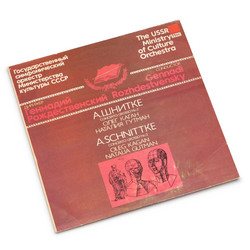
Alfred Schnittke
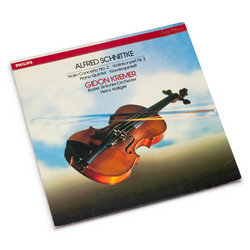
Violin Concerto No.2 / Piano Quintet (LP)
condition (record/cover): NM / NM
Alfred Schnittke invented the term "polystylism" to describe what he was doing, and the term is both accurate and insufficient. What it describes literally - the simultaneous or sequential use of radically different historical styles within a single work - does not account for the emotional logic behind it, which is not collage for its own sake but something closer to what Richard Taruskin called "I-against-the-world": the individual consciousness adrift in a sea of received languages, unable to speak purely in any of them and unable to stop speaking altogether. Born in 1934 in the Volga German Autonomous Republic, Schnittke spent his earliest musical years in Vienna, an experience he described as living proof of the past's continued presence. Back in Moscow, he supported himself for decades composing film scores - over sixty of them - while his concert works circulated in samizdat, their premieres unofficial, their reception by the Composers' Union hostile.
This LP pairs two works from different registers of his output. The Violin Concerto No.2 (1966) is an early, restless essay in polystylism: lyric arioso collides with avant-garde extended techniques, a deliberate "forest music" passage in German Romantic idiom fractures the modernist surface before dissolving into a chorale of Russian Orthodox cast. Gidon Kremer, who was instrumental in bringing Schnittke to Western audiences, performs. The Piano Quintet (1972-76) is an entirely different register - written in response to his mother's death in 1972 and rooted in something closer to Shostakovich than to any historical pastiche. Keening strings, dark trills, a second-movement waltz that distorts under its own weight. The work was later orchestrated and retitled In Memoriam. Liner notes by the composer and by Günther Mayer in English, German, and French. Original Philips pressing.