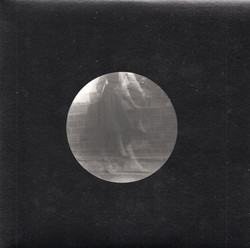
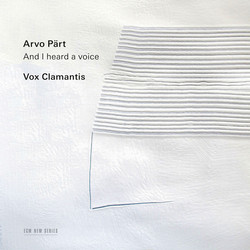
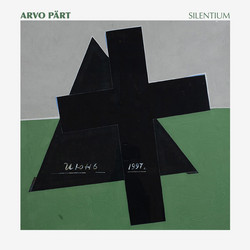
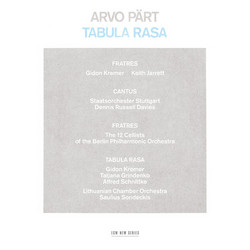
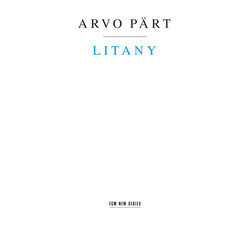
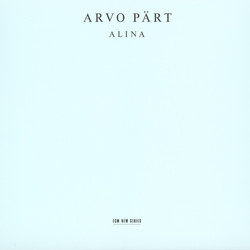
It's unlikely that many will have missed the fact that ECM - an unparalleled home for groundbreaking music, whose catalog has predominantly been restricted to the CD format since the 1980s - has begun releasing stunning, beautifully produced audiophile vinyl pressings of a select number of their most in-demand releases. Among the most requested to receive this treatment, Arvo Pärt's 1999 full-length, Alina, has long topped their list. Finally, such a dream has come to be with its multiple renderings of two of the composer's most beloved works - the solo piano piece, Für Alina, and the captivating strings and piano duet, Spiegel im Spiegel - receiving their first ever vinyl pressing. Foundational works in the composer's pursuit of mystical minimalism, as well as being some of the most captivating and emotively poetic sounds ever laid to tape, it's hard to imagine 2026 delivering a more hotly anticipated reissue than this!
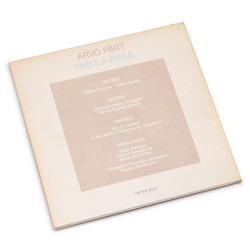
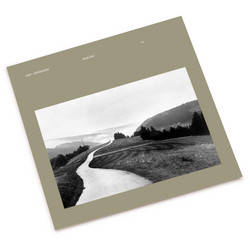
Resting high among names like Blue Note and Impulse, few labels have had lasting impact and influence as the German imprint, Edition of Contemporary Music, more commonly known as ECM. Founded by Karl Egger, Manfred Eicher and Manfred Scheffner in 1969 and launching into action with Mal Waldron's legendary Free at Last - embracing the motto of "the most beautiful sound next to silence" - for more than half a century the label has set a gold standard for groundbreaking creativity and recording fidelity. While ECM largely became associated with a new era in the history of jazz, working with artists like Paul Bley, Keith Jarrett, Jan Garbarek, Pat Metheny, Gary Burton, Chick Corea, Charlie Haden, Don Cherry, Dave Holland, Terje Rypdal, and numerous others, in 1984 the label launched its "New Series" as a vehicle to document and distribute important contemporary efforts of Western chamber and orchestral music, initiated with the Estonian composer Arvo Pärt's Tabula Rasa. The New Series rapidly emerged as a highly acclaimed platform for contemporary composition over the coming decades, releases important works by Meredith Monk, Gavin Bryars, John Adams, Steve Reich, and numerous others, no single artist has become more strongly associated with it, and arguably ECM in general, than Arvo Pärt, the composer who helped bring it to be. For more than 40 years, the series, imprint, and composer have maintained a mutually defining collaboration that has witnessed Pärt emerge as one the most distinct voices in late 20th and early 21st Century Minimalism. Given the era, over the last 40 or so years, during which much of Pärt's work has appeared, the vast majority has been limited to the format of CD. Thankfully, ECM has been recently digging into its incredible back catalog, issuing deluxe audiophile reissues of select releases, which has now arrived at the first ever vinyl pressing of one of Pärt's most beloved full-lengths: 1999's Alina. Profoundly poetic and restrained, comprising two different renderings of the solo piano piece, Für Alina, and three of the captivating strings and piano duet, Spiegel im Spiegel - each drawing out the subtle nuances through each respective rendering - once heard there can be little question regarding why it has long topped the list of ECM New Series titles requested as a vinyl release. Gloriously mastered and pressed on wax for the very first time - housed in cardboard single sleeve that perfectly reproduces the original CD issue, accompanied by four-page insert with liner notes by Hermann Conen - it's absolutely essential for any fan of Pärt or Minimalism in general, as well as being the perfect place for new listeners to begin exploring the composer's work.
Born in Estonia in 1935, despite being almost exactly the same age as American counterparts like Terry Riley, Steve Reich, Philip Glass, and La Monte Young - and thus can be seen to share certain generational zeitgeists - the composer, Arvo Pärt, stands distinctly apart within the iconic cannon of minimalist music. Upon reflection, that one who emerged behind the Iron Curtain at the height of the Cold War would bear different sensibilities from those nurtured by American capitalism should be unsurprising, but over the course of his career Pärt has expressed his singularity on often less than expected terms. Pärt began his musical training at the age of seven and began composing while he was still in his teens before entering the Tallinn Conservatory, where he studied composition with Heino Eller, while simultaneously working as a composer for over fifty films and numerous theater productions, before completing his studies in 1963. Pärt's earliest efforts tended to nod toward the neoclassicism of Shostakovich, Prokofiev, and Bartók, but before long he began to deploy avant-garde techniques like Schoenberg's twelve-tone system, resulting in the Soviet establishment banning his efforts during which the composer entered states of silence and despair, during which he studied choral music from the 14th to 16th centuries, while regarding the act of contemporary composing as futile.
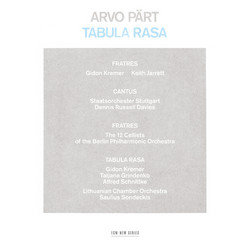
While spirituality is certainly not absent from the canon of 20th Century avant-garde music - composers like Harrison, Cage, Riley, and Young all drew from traditions of Eastern spiritual music - Pärt remains fairly distinct in the relationship between his work and personal devotion to Christianity. Rather than looking to cultures beyond Europe to supply inspiration for the radical breaks of the avant-garde, Pärt looked back in time for sonic roots within his own faith, studying early polyphonic liturgical music, plainsong, Gregorian chant, and the sounds of the European Renaissance. It would be these touchstones that began to distill within his Third Symphony, in 1971, and come into full expression during the late 1970s through now famed works like Fratres, Cantus in Memoriam Benjamin Britten, Tabula Rasa, and Spiegel im Spiegel, as well as large scale works like Te Deum during the following decade and place him as a pioneer of mystic minimalism or holy minimalism, alongside contemporaries like Henryk Górecki and John Tavener. Unsurprisingly, Pärt's deep dedication to spiritual content placed him at further odds with Estonia's communist government, leading to further bans. Thankfully, audiences on the other side of the Iron Curtain began to take note, leading to the German imprint launching their "New Series", dedicated to documenting and distributing important contemporary efforts of Western chamber and orchestral music, with the first ever release of Pärt's previously unrecorded 1977 work, Tabula Rasa: beginning a lasting collaboration with the composer that would result in his becoming one of the most celebrated composers of his generation. As Steve Reich once wrote: "Even in Estonia, Arvo was getting the same feeling that we were all getting... I love his music, and I love the fact that he is such a brave, talented man… He's completely out of step with the zeitgeist and yet he's enormously popular, which is so inspiring. His music fulfills a deep human need that has nothing to do with fashion."
Unsurprisingly, given the prolific nature of Pärt's composing and the fact that his work remained largely suppressed and remained unrecorded in his own country for many years, it took some time of a full sense of his sensibilities and output to emerge across the global landscape of music. It wasn't until 1995 that he had the opportunity to record two of what would become his most wildly celebrated pieces: 1978's Spiegel im Spiegel and 1976's Für Alina, which would appear four years later as Alina, his eighth release with ECM. Both are among his most elegantly poetic and simple compositions - capturing his early tintinnabuli style - distilling a profound sense of emotion and meaning into their arraignments of tonality. As stated at the time: "I could compare my music to white light which contains all colours. Only a prism can divide the colours and make them appear; this prism could be the spirit of the listener." Contemporary reviewers suggested that carefully following the flow of Alina would heighten perception. Gramophone described the album as "the voice of internal exile, self-communing and highly personal but wholly accessible for anyone willing to listen. The big danger of listening to Alina is that much of what you hear afterwards will suddenly sound like noise – too much noise. But it's a risk worth taking."
The contents of Alina, two different solo piano renderings of Für Alina, and three of the captivating strings and piano duet, Spiegel im Spiegel, were culled from a significantly larger body of recordings made when Pärt and Manfred Eicher convened at Frankfurt's Festeburgkirche with the album's four contributing musicians: the violinist Vladimir Spivakov, the cellist Dietmar Schwalke, and the pianists Alexander Malter and Sergej Bezrodny. Beginning with a rendering of Spiegel im Spiegel that clocks in at just over ten and half minutes, featuring Bezrodny and Spivakov (who commissioned the work), the ear is immediately immersed in the form of minimalism for which Pärt has become most famed, balancing an incredible state of emotiveness and meditativeness that distills sonority to its most necessary and elemental, as the piano's notes slowly fall like drops of water and the violin delivers gliding tones imbued with an ecstatic sense of sorrow and loss. This is followed by the first rendering, by Alexander Malter, of Pärt's breakthrough solo-piano work Für Alina. "Jettisoning everything except the essential, it has no fixed metre or tempo", but rather calls for a "calm, exalted" feeling and "listening to one's inner self" in the performance notes of the score, leading the composer, pianist, and producer to search for distinct ways of inflecting its melody, paying meticulous attention to phrasing and dynamics and to the surrounding silence in the Frankfurt church, that resulted in its stunning first rendering that allowed each note to hang powerfully in the air and carefully respond the to the next.
In many ways, while the first encountered renderings of Für Alina and Spiegel im Spiegel are definitive and could more than satiate any listeners, it is their companions, alternate performance of both pieces by Alexander Malter (Für Alina) and the cellist Dietmar Schwalke and Alexander Malter (Spiegel im Spiegel) that truly make the record what it is, drawing out subtle differences in their open potential for interpretation, particularly with regard to emotion and delivery, and thus illuminating how dynamic Pärt's deceptively simple compositions actually are. In every passing moment, these respective performances are equally impactful as their predecessors, while complimenting them in unexpected ways, becoming almost mantra like, over the course of the album, through their repetition and variation. As Hermann Conen puts it in the companion liner notes, the album finds its form by "concentrating on an indispensable core of material."
A truly remarkable accomplishment on every possible set of terms, at long last two of the most celebrated works by Arvo Pärt appear on vinyl for the very first time, via the always amazing ECM, their original home. Beautifully produced and pressed, housed in cardboard single sleeve that perfectly reproduces the original CD issue, accompanied by four-page insert with liner notes by Hermann Conen, this is quite simply one of the most important records to appear in the last 30 years within the field of contemporary chamber music and can not be missed.