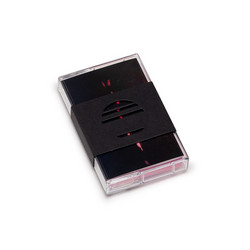
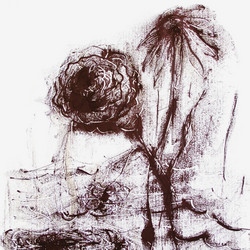
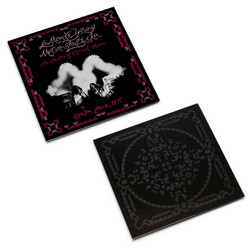
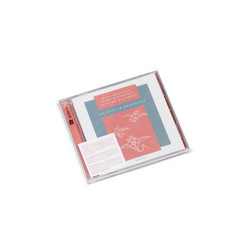
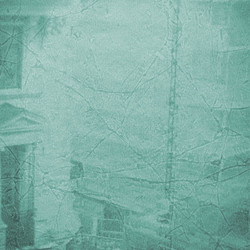
*50 copies limited edition* »A Grey City With Its Beast« is a solo recording for choor khuur, composed and performed by Anqi Liu and recorded in San Diego in 2026. The choor khuur is an older Mongolian bowed instrument related to the morin khuur, yet it has its own construction and behaviour: a skin-covered body, horsehair strings and bow, a sound peg, and a Mongolian knife inserted between the bridge and body permit minute adjustments of tuning and timbre. Temperature, humidity, pressure, and the physical state of the instrument can all alter the sound. Liu works directly within that responsiveness and instability, treating it not as a problem to solve but as an integral feature of the instrument.
The ideas surrounding the album are developed at greater length in Liu’s accompanying essay and in her 2025 doctoral dissertation, »Towards the Ecology of Fraysonics«. The dissertation describes sound as a ›fray-field‹, a tensile ecology formed where instrument, body, environment, and history meet. Within this framework, fragility becomes a site of production, responding unpredictably and imparting traces of lived negotiation. Liu calls one aspect of this historical wear Attrisonance: the way sonic practices are stretched and reshaped as they pass through changing environments, technologies, institutions, and languages. The choor khuur itself gives unusual tangibility to these questions posed by Liu. Her research traces how the older skin-bodied instrument and the modern morin khuur became connected through a living history of adaptation. The morin khuur, increasingly intended for larger stages and formal institutions, favoured projection, brightness, and tuning stability, while the choor khuur’s calfskin body, loose-hair bow, and environmental sensitivity offered a more intimate and volatile soundworld. In Liu’s dissertation, the traditional and modern instruments belong to the same braid and display evidence of a continuity shaped by changing needs.
Liu is careful to resist a simple opposition between tradition and modernity or centre and margin. Her field research emphasises a significantly more nuanced and entangled sonic ecology, where musicians, makers, teachers, institutions, landscapes, and practical needs continually impact one another. Across the three works here, the choor khuur is heard in close detail without being made to stand in as a fixed emblem of heritage. Its material is allowed to remain active, unstable, and contemporary, carrying memory while producing new sonic relations in the present. Liu suggests a new sonic language for an instrument which could easily be relegated to a museum piece. The bow continually tests thresholds between tone and friction, creating breath-like noise and near-disappearance. Small changes in pressure or position can reorganise the traditional materiality of the instrument. Liu’s concept of Threshography, developed in her research as a practice for working at the edge of sonic formation, is useful here even when the album does not present itself as a demonstration of a theoretical system. The music depends on broadly the same concepts: maintaining a gesture close to instability and listening to how the instrument answers in real time.
Across »Cinereus Nativitas«, »Cinerea Fera«, and »Smog Unbroken«, this sensitivity accumulates into an austere but highly physical listening environment. In these compositions, instability is held as the continual negotiation of history, both personal and cultural, environment, and the ongoing act of listening. An excerpt from »A Grey City With Its Beast«: Perhaps this is what this album has been trying to understand all along: how experimentality itself is historically produced. The sound changes very little. The conditions of hearing change everything. Perhaps this album is also one more attempt to return to the child who heard sound long before she understood how the world had already decided what could be heard as art.

![Σ [sigma]](https://cdn.soundohm.com/data/products/2026-10/a0550686140_10-jpg.jpg.250.jpg)