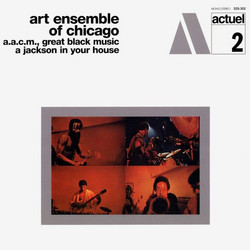
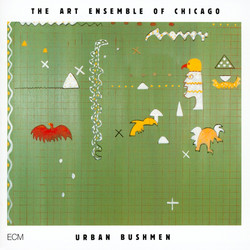
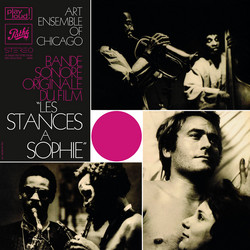
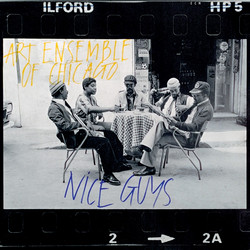
** 2026 stock ** Early Combinations opens a window onto the Art Ensemble of Chicago before it had a fixed name or a fully settled lineup. Recorded in 1967 and first made widely available only in 2012, the album stitches together two extended sessions that capture the band’s concept in mid‑formation. As the title suggests, this is the Art Ensemble as a work in progress: three parts Roscoe Mitchell Art Ensemble and three parts Joseph Jarman quartet, overlapping personnel and repertoires as the musicians test how their ideas fit together. The music we now recognise as central to the group’s identity is still being worked out in real time, but the signatures - tight themes, explosive collective improvisation, a playful seriousness about structure - are already unmistakable.
The first piece, Jarman’s “A to Ericka,” was recorded as an audition tape for a Polish jazz festival. It didn’t succeed in getting the band to Europe, but the music itself reveals a group already thinking beyond the standard festival script. The ensemble here blends Jarman and Mitchell on saxophones with Lester Bowie on trumpet, Malachi Favors and Charles Clark on basses and Thurman Barker on drums, creating a dense but agile front line over a flexible, two‑bass foundation. Jarman’s composition, rooted in material he’d been developing since 1966, unfolds as a long, episodic arc: themes surface and re‑surface in altered form, shout‑choruses and collective riffs punctuate freer passages, and the players punctuate lines with spoken “Hey!”s that make the performance feel as much like a ritual dance as a jazz audition.
The second track, “Quintet,” comes from what was essentially a dress rehearsal for a concert that never happened. The gig was cancelled on the day of the performance, but engineer Terry Martin’s tapes preserved the run‑through, which turns out to be more than strong enough to stand on its own. This time the instrumentation shifts slightly - Mitchell, Jarman, Bowie and Favors are joined by drummer Thurman Barker without the extra bass - giving the music a sparer, more exposed profile. Where “A to Ericka” leans into Jarman’s compositional voice, “Quintet” feels closer to the Roscoe Mitchell Art Ensemble side of the equation: crooked heads, open‑ended group improvisations, sudden shifts in texture and density. You can hear the band testing balances between written material and free play, between chamber‑like restraint and full‑tilt collective sound.
Both “A to Ericka” and “Quintet” first surfaced in the limited‑edition 1993 box set Art Ensemble 1967/68, where they sat alongside the music later issued as Old/Quartet. Extracted and presented together on Early Combinations, they read as a focused snapshot of 1967, a year in which the Art Ensemble’s core quartet - Mitchell, Jarman, Bowie and Favors - was coalescing around shared methods even as configurations and drummers shifted. The sessions took place at or around Lester Bowie’s home, in conditions far from a formal studio, yet the playing is anything but tentative. The group’s characteristic mix of discipline and play is already in place: thematic clarity, sharp dynamic contrasts, an ear for silence as a structural element, and a willingness to push into noisy, rough‑edged territory without losing the thread.
In hindsight, the ironies pile up: music meant to secure a festival slot that never materialised, and a rehearsal for a gig that was cancelled outright, ultimately reaching a far larger audience on record than those concerts ever could have. Early Combinations documents these near‑misses as vital early chapters in a story that would soon become central to avant‑garde jazz. It shows the Art Ensemble’s grammar being forged in the friction between Roscoe Mitchell’s and Joseph Jarman’s ensembles, at a moment when the names on the tape boxes had not yet caught up with the sound being invented inside them.