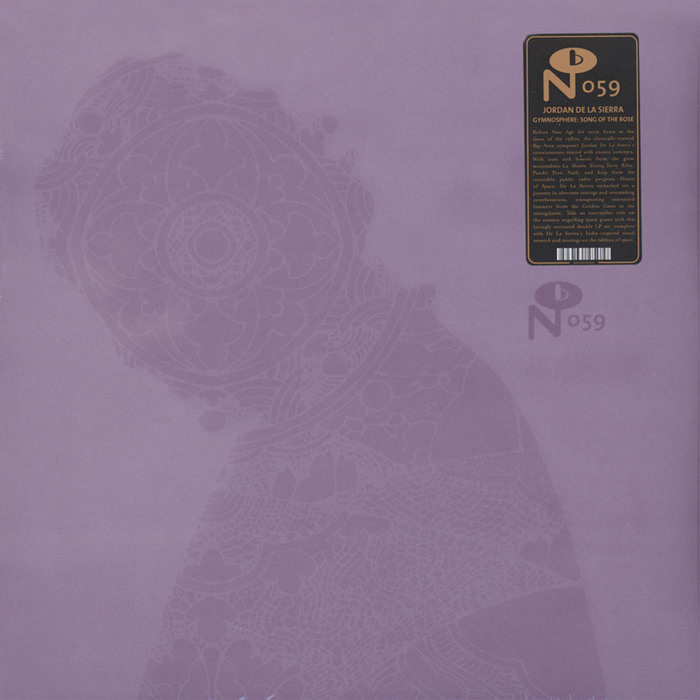
Jordan De La Sierra
Gymnosphere: Song of the Rose (2CD)
Tracked express shipping from Italy, no customs or import VAT in the EU. Shipping costs
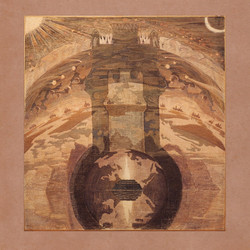
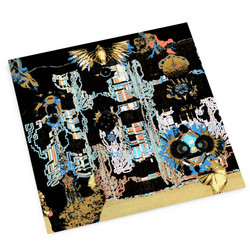
2CD Edition. Before New Age hit terra firma at the dawn of the 1980s, the classically-trained Bay Area composer Jordan De La Sierra's consciousness soared with cosmic concepts. With cues and lessons from the great minimalists La Monte Young, Terry Riley, Pandit Pran Nath, and help from the venerable public radio program Hearts of Space, De La Sierra embarked on journey in alternate tunings and resounding reverberations, transporting entranced listeners from the Golden Gates to the intergalactic. Take an interstellar ride on the sensory engulfing space piano with this lovingly recreated double LP set, complete with De La Sierra's India-inspired visual artwork and musings on the tableau of space. "Jordan De La Sierra's Gymnosphere: Song of the Rose was originally released as a double album accompanied by a deluxe booklet by the tiny Unity Records in 1977; it is one of the first "new age" records, released years before the genre "officially" existed. But that association doesn't tell the story of the timeless music on offer here. De La Sierra was a student of Terry Riley's and Pandit Pran Nath's. Here he employs minimalism and Just Intonation (hence the term "well tuned piano" in the subtitle). In just intonation, the frequency of notes is tuned in ratios of whole numbers; they ring in complete harmony with one another; there is no dissonance. De La Sierra's compositions were recorded in a small basement studio and were produced by Stephen Hill (then host of the radio program Hearts of Space -- and later the founder of its namesake label, the most innovative in the new age genre). Hill, De La Sierra, and a small host of engineers armed with tape recorders and microphones took the tapes to the cavernous Grace Cathedral and played them at the walls. The massive natural reverberations were captured, and the results of these two "performances" were mixed together. De La Sierra's playing technique is deliberate, slow, repetitive, precise.
There are four long pieces here, each in the vicinity of 25 minutes. Because of the natural reverb, each phrase continually feeds into the next, and the echoes combine, recombine, and resonate, creating microtones and timbres that come to the fore in new sounds, eventually decaying into silence to be replaced by others. The music is mysterious, elegant, elliptical; it's tender, searching, and emotionally wide open. The Grace Cathedral is not so much a space as an essential collaborator. This album is a seamlessly wrought whole that combines American minimalism with the European sonic experimentation that was happening more or less simultaneously. Musical referents perhaps are Riley's Persian Surgery Dervishes and The Harp of New Albion, and even LaMonte Young's The Well Tuned Piano -- though De La Sierra's music is intentionally more melodic.
But three titles from Brian Eno's Obscure label on the other side of the Atlantic -- Gavin Bryars' Sinking of the Titanic (1975), David Toop and Max Eastley's New & Rediscovered Instruments (1975), and "1-100" by Michael Nyman off Decay Music (1976) -- are more aesthetically simpatico due to their reliance on natural decay. De La Sierra's intent -- "playing the music of the cosmos" -- and homespun philosophy are deeply entrenched in post-hippie Eastern spirituality, as evidenced by his drawings and musings in the accompanying booklet. As such, they relate directly to the Bay Area's emergent new age scene, making this document inseparable from its history. That said, it ultimately makes no difference. The application of disciplined technique, creative imagination, and sonic adventure make Gymnosphere: Song of the Rose not a curio, but a West Coast American masterpiece of the 1970s." All music guide
Format
Subtitles:
Music From The Hearts Of Space
To The Rose With Love
Comes in standard 2CD jewelcase in a cardboard slipcase.
Release notes
Subtitles: Music From The Hearts Of Space To The Rose With Love Comes in standard 2CD jewelcase in a cardboard slipcase.
| 1-1 | Music For Gymnastics | 24:00 | |
| 1-2 | Temple Of Aesthetic Action | 24:00 | |
| 2-1 | Music For Devotional Pastimes | 27:00 | |
| 2-2 | Sphere Of Sublime Dances | 27:00 |
- Jordan De La Sierra
- Artwork By [Album Design], Composed By, Performer, Producer
- Vincent Garner
- Artwork By [Camera Graphics]
- Patricia Joyce
- Artwork By [Logos]
- Leland Meiners
- Design [Reissue]
- Timothy Breen
- Design [Reissue]
- Robert Rich
- Engineer [Digital Restoration]
- Peter Georgi
- Executive Producer
- Erin Osmon
- Liner Notes
- Paul Stubblebine
- Mastered By
- Michael Gore
- Mastered By [Original]
- Ken Shipley
- Producer [Reissue]
- Rob Sevier
- Producer [Reissue]
- Stephen Hill
- Recorded By, Producer, Remastered By