Mieko Shiomi
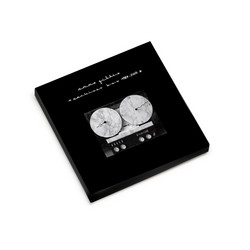
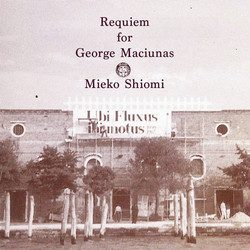
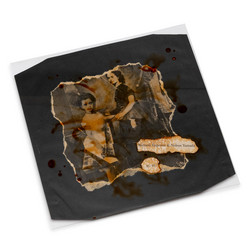
Requiem For George Maciunas (LP + A4 Booklet)
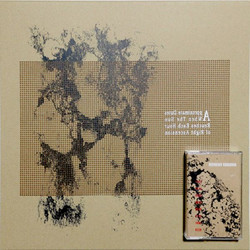
A vital tape work returning to circulation thirty-six years after its private cassette debut. Originally self-released by Mieko Shiomi in 1990 as a memorial offering for George Maciunas, this haunting requiem now receives its first ever vinyl edition, mastered by Giuseppe Ielasi, with the two sides of the original cassette restored to their intended A/B form and accompanied by a download code.
By 1990 Shiomi had already lived several musical lives. A founding member of Group Ongaku alongside Takehisa Kosugi and Yasunao Tone at the dawn of the 1960s, she had helped open Japanese postwar music to free improvisation, action, and the sounding of "objet sonor"; from 1964, working briefly in New York and then by mail from Osaka, she had become one of Fluxus's most quietly inventive voices, the author of Endless Box, the Spatial Poem series, and Disappearing Music for Face. The invitation to the Sub-Atomic Fluxus Festival held in Venice in 1990 marked a turning point. Returning to Japan with Venetian field recordings in hand, she set down a tape work whose private circulation across the decades has only deepened its aura.
The piece operates on a strict and beautiful conceit. Side A, Ubi Fluxus, is composed from the ten pitches whose German names spell out, letter by letter, George Maciunas: C, Cis, Es, E, Eis, Ges, G, As, Ais, Ces. Shiomi performs them on synthesised harpsichord and organ, the sustained, slightly artificial timbres carrying the cipher with a strange tenderness. Across this cantus the field recordings she made at the Fluxus pavilion in Venice on the festival's opening day drift in and out, voices and ambient sound figured by the composer as gusts of wind carrying messages skyward. Among them are the voices of La Monte Young, Marian Zazeela, Eric Andersen, Willem de Ridder, and Ken Friedman, fellow travellers offering their own farewells. Side B, ibi Motus, is the entire side A played backwards, an inversion that turns the requiem into a mirror, with messages audible only when the tape is reversed.
The Latin inversion of the side titles, Ubi Fluxus / ibi Motus, "where there is flux, there is motion", binds the work into a single conceptual gesture. It is one of the most intimate documents to emerge from Fluxus's later years, and one of the most quietly radical pieces in Shiomi's catalogue, a tape composition whose very materiality, its directionality, its ability to be reversed, its capacity to carry voices across decades, is folded into the composition itself.
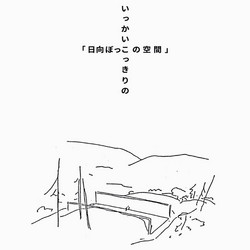
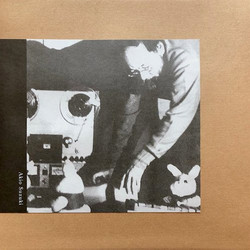
This LP edition is accompanied by an A4 eight-page booklet in Japanese and English, with a newly written commentary by Shiomi, photographs taken at the Venice festival, and reproductions of the score. Mastered by Giuseppe Ielasi, with download code included.





















![Eyry]](https://cdn.soundohm.com/data/products/2025-11/anne-gillis-art-into-life-jpg.jpg.250.jpg)