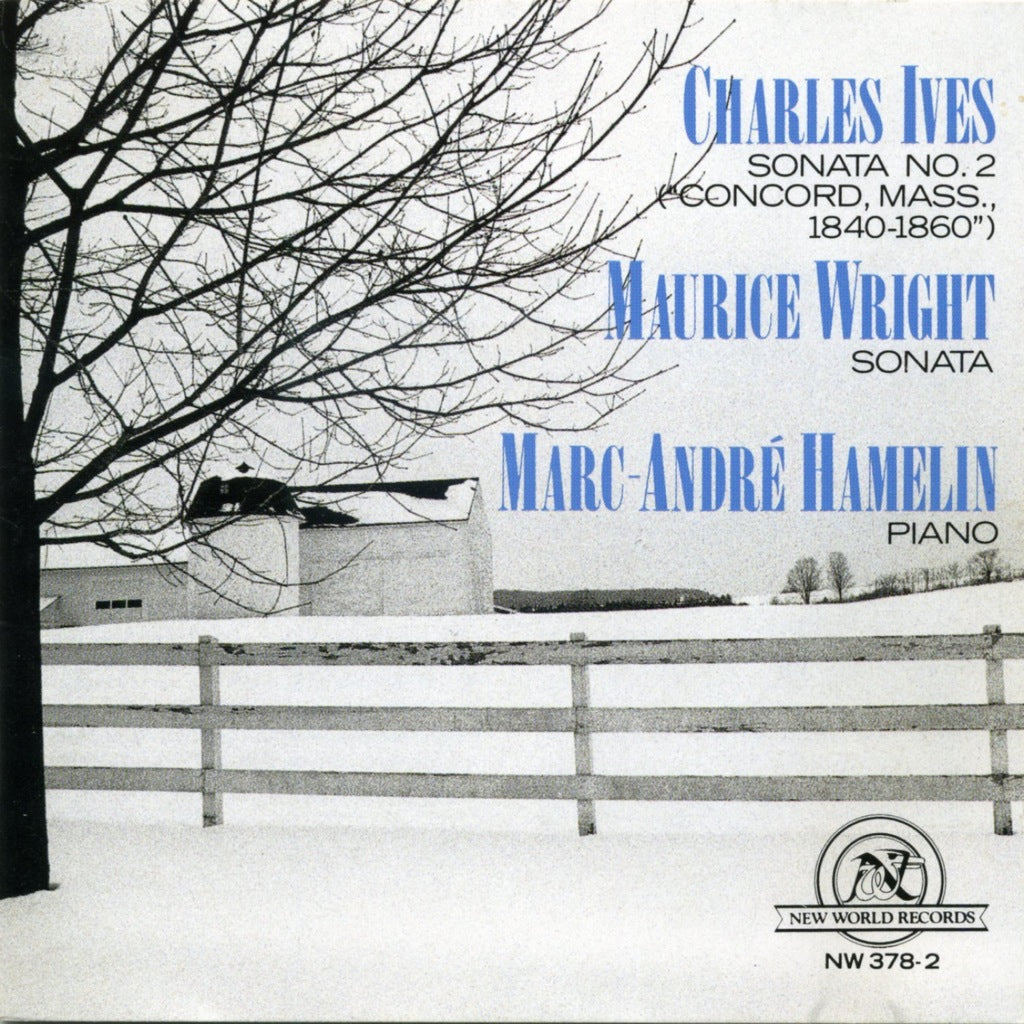
Charles Ives, Maurice Wright, Marc-André Hamelin
Sonata No. 2 ( "Concord, Mass., 1840-1860") - Sonata (CD)
FormatCDLabelNew World RecordsGenreComposition
Out of stock
Tracked express shipping from Italy, no customs or import VAT in the EU. Shipping costs
“This is not a nice sonata for a nice piano player,” wrote Charles Ives about his most famous work, “but something the writer had long been thinking about.”
All four movements were programmatically conceived around figures in the Transcendentalist movement (c. 1936-1860) in Concord, Massachusetts. The “Emerson” movement had begun as a piano concerto, the soloist representing Ralph Waldo Emerson, and the orchestra, the masses listen to him; “Hawthorne” was conceived for “a piano or a dozen pianos;” “The Alcotts” for organ or piano with voice or violin; and “Thoreau” for strings colored by flute or horn.
One of the most wide-ranging piano works ever written, the Concord is also one of the most intuitively unified. Despite his use of such avant-garde devices as polytonality, sound clusters, and un-metered rhythm, Ives remained a true Hegelian romantic, as is apparent from his idealist exclamation, “My God! What has sound got to do with music!” And as a work at once supremely romantic and technically innovative, the Concord Sonata exists at, and helps define, that exquisite moment when Romanticism, in feverish pursuit of its ideals, erupted into Modernism.
Few recent piano works can stand next to the Concord so well as Maurice Wright’s Sonata of 1982. Like Ives, Wright draws complexity from the simplest materials-in this case, a falling, four-note scale figure and a series of (usually five) repeated notes, both present in the opening chords. In the first movement both figures make up a slow, simple (if dissonant) introductory melody, leading to a lightning-quick rhapsody fueled by the scale motive turned upwards. The second movement begins with that same rising motive built up haltingly and marked “as if asleep....” The powerful third movement alternates between quintuply-repeated chords and the scale motive, now marching up and down in military gait. In between there are lyrical movements: The first movement is graced by a lilting second theme in triple meter, the second by a quiet, minor-key chorale enlivened by chromatic inner voices.
Format
Liner notes in English
Made in U.S.A. | Printed in U.S.A.
Recordings:
Tracks 1-3 : January 22, 1987
Tracks 4-7 : July 18 and 19, 1988
Release notes
Liner notes in English Made in U.S.A. | Printed in U.S.A. Recordings: Tracks 1-3 : January 22, 1987 Tracks 4-7 : July 18 and 19, 1988
| Sonata | |||
| 1 | I. | 4:47 | |
| 2 | II. | 5:51 | |
| 3 | III. | 4:27 | |
| Sonata No. 2 ("Concord, Mass., 1840-1860") | |||
| 4 | I. Emerson | 16:17 | |
| 5 | II. Hawthorne | 10:32 | |
| 6 | III. The Alcotts | 5:36 | |
| 7 | IV. Thoreau | 11:24 | |
- Bob Defrin
- Design
- James Rich
- Edited By
- Paul Zinman
- Edited By
- Timothy Martyn
- Edited By, Engineer (1 to 3)
- Henk Kooistra
- Engineer (4 to 7)
- Paul Goodman
- Engineer (4 to 7)
- Kyle Gann
- Liner Notes
- Marc-André Hamelin
- Piano
- Elizabeth Ostrow
- Producer


