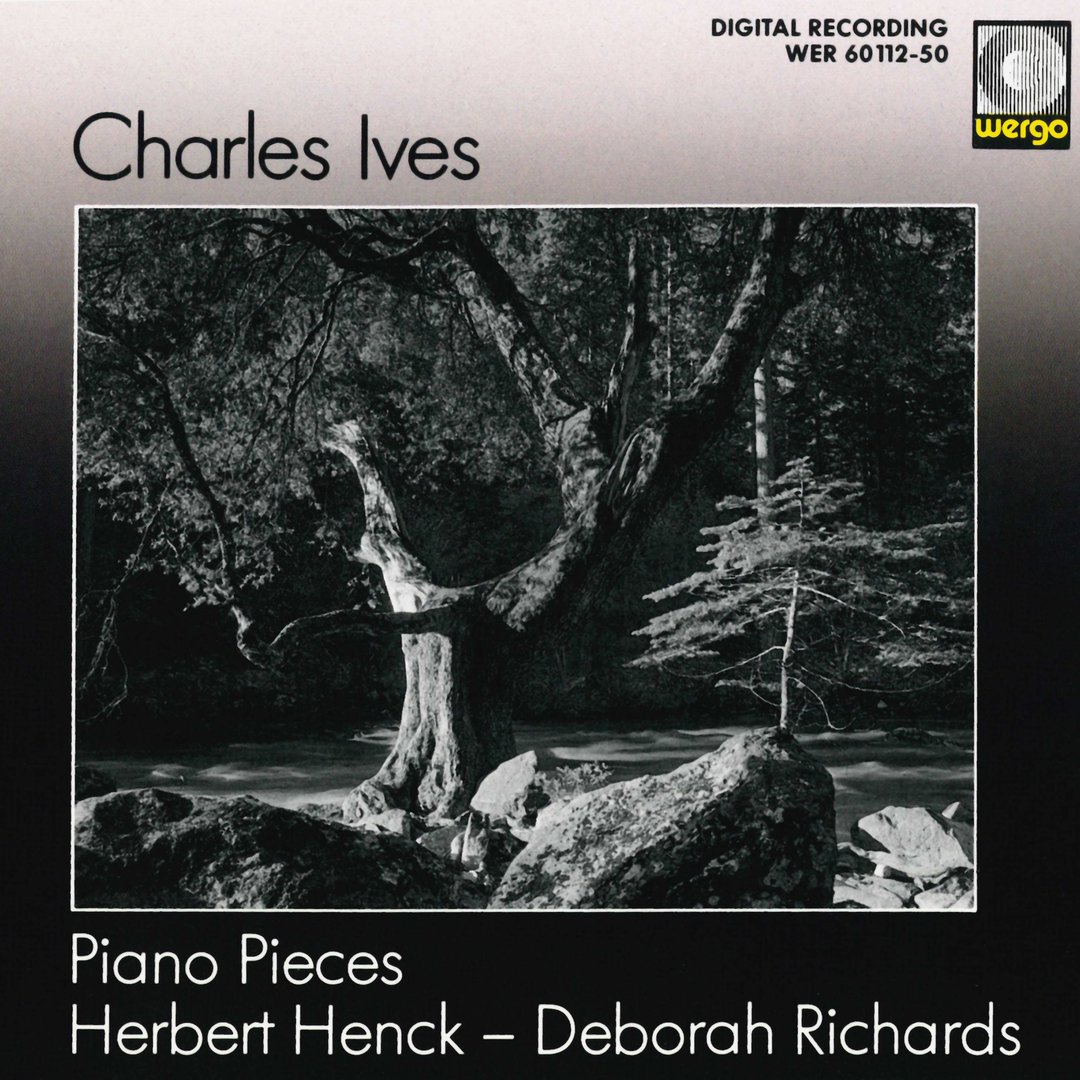
Charles Ives
Piano Pieces
FormatCDLabelWergoGenreComposition
Arriving from the supplier: On backorder (ships as soon as it reaches us)
Tracked express shipping from Italy, no customs or import VAT in the EU. Shipping costs
Besides his two large piano sonatas, Charles Ives wrote a body of shorter piano pieces, and this disc gathers those that had been published. Played by Herbert Henck, with Deborah Richards joining him for the quarter-tone pieces, the programme works as a cross-section of Ives's output. The production received the quarterly German Record Critics' Award.
Charles Ives was an American composer whose music took in everything around him, from church hymns to band marches. Henck, a German pianist born in 1948 and a specialist in twentieth-century repertoire, had already recorded the Concord Sonata for Wergo; he also wrote the booklet notes for this disc. The recording was made in July 1984 in Studio 3 of the Bayerischer Rundfunk in Munich, in co-production with the radio, with Helene Steffan directing and Hans Schmid as engineer.
The titles say a lot about the music. Study No. 20 is subtitled "Even Durations, Unevenly Divided", Study No. 21 "Some South-Paw Pitching!", and Study No. 9 "The Anti-Abolitionist Riots in the 1830's and 1840's". Varied Air and Variations is labelled a study "for ears or aural and mental exercise". Marches, chorales, ragtime, waltzes, popular American songs and classical quotations appear, often in the same piece, along with sounds that seem to recede or approach from a distance. Thick contrapuntal passages sit next to wit and pathos, and the Waltz-Rondo and the Three-Page Sonata show how freely Ives handled inherited forms. Study No. 20 is the longest piece at ten minutes, while No. 21 and No. 22 last little more than two each. The disc ends with the Three Quarter-tone Pieces for Two Pianos, Ives's excursion beyond equal temperament, with Richards at the second piano.
The Wergo notes stress how these pieces refer to each other and to Ives's larger works, and how his method resisted the exclusion of any musical material. Traditional styles, forms, playing techniques and performance conventions are taken up and pushed to the point of disintegration. This is why the label places Ives among the truly experimental composers of his century, with ideas later carried further by John Cage.
CD, Wergo WER 60112-50, released in 1985, with a 22-page booklet in German and English. Total time 53'05.
Release notes
Recorded in co-production with Bayerischer Rundfunk in Munich, BR (Studio 3), July 1984. 22-pages booklet contains information on the presented works and the performers both in German and English.
| 1 | Study No. 20: Even Durations - Unevenly Divided | 10:08 | |
| 2 | Study No. 21: Some South-Paw Pitching! | 2:21 | |
| 3 | Study No. 22 | 2:32 | |
| 4 | Varied Air And Variations - Study # 2 For Ears Or Aural And Mental Exercise!!! | 6:18 | |
| 5 | Waltz-Rondo | 5:17 | |
| 6 | Three-Page Sonata | 8:59 | |
| 7 | Study No. 9: The Anti-Abolitionist Riots In The 1830's And 1840's | 4:13 | |
| 8 | Three Quarter-Tone Pieces For Two Pianos | 12:14 |
- Charles Ives
- Composed By
- Helene Steffan
- Directed By
- Hans Schmid
- Engineer
- Ansel Adams
- Photography By [Photograph By]
- Deborah Richards
- Piano [Piano 2] (8)
- Herbert Henck
- Piano, Liner Notes