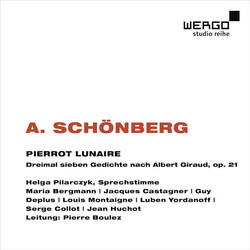
Arnold Schoenberg's Serenade op. 24, for seven instruments and low male voice, is one of the historically significant works of the early 1920s. It belongs to the period when Schoenberg was developing what he called "composition with twelve tones related to each other", and it shows the twelve-tone technique in one of its earliest and most rudimentary forms. This recording is conducted by Pierre Boulez.
Schoenberg (1874-1951) was an Austrian and later American composer and teacher. Boulez (1925-2016), the French composer and conductor, had studied with Messiaen and privately with René Leibowitz, through whom he absorbed the Schoenberg tradition. His recording of the Serenade was made in Paris in 1961 and first issued in 1962 on the French label Disques Adès. The players are Guy Deplus (clarinet), Louis Montaigne (bass clarinet), Paul Grund (mandolin), Paul Stingl (guitar), Luben Yordanoff (violin), Serge Collot (viola) and Jean Huchot (cello), with the bass Louis-Jacques Rondeleux as the singer.
The scoring is unusual: clarinet and bass clarinet, mandolin and guitar, and a string trio. The work is in seven movements, composed between 1920 and 1923. A Marsch opens and a Finale closes it, and between them come a Menuett, a set of Variationen, a Tanzscene and a Lied (ohne Worte). At the centre is the only vocal movement, a setting of Petrarch's Sonnet No. 217, sung by Rondeleux. The movements were not written in order: the theme of the Variationen dates from 1920, the Marsch from 1921, the sonnet from 1922-23, and the Lied and Finale from 1923.
The Serenade was first heard privately in Vienna on 2 May 1924, at the home of Norbert Schwarzmann. Its public premiere followed at the Donaueschingen festival on 20 July 1924, conducted by Schoenberg himself. The score was published by Wilhelm Hansen. In 1963 the Boulez recording appeared in Germany on an LP numbered WER 60002, one of the first in the Wergo catalogue. This CD brings it back, remastered, in Wergo's studio reihe series.
CD, Wergo WER 6780 2, released in 2017, 31 minutes, with a 48-page booklet; a remastered reissue of the 1961 Paris recording.