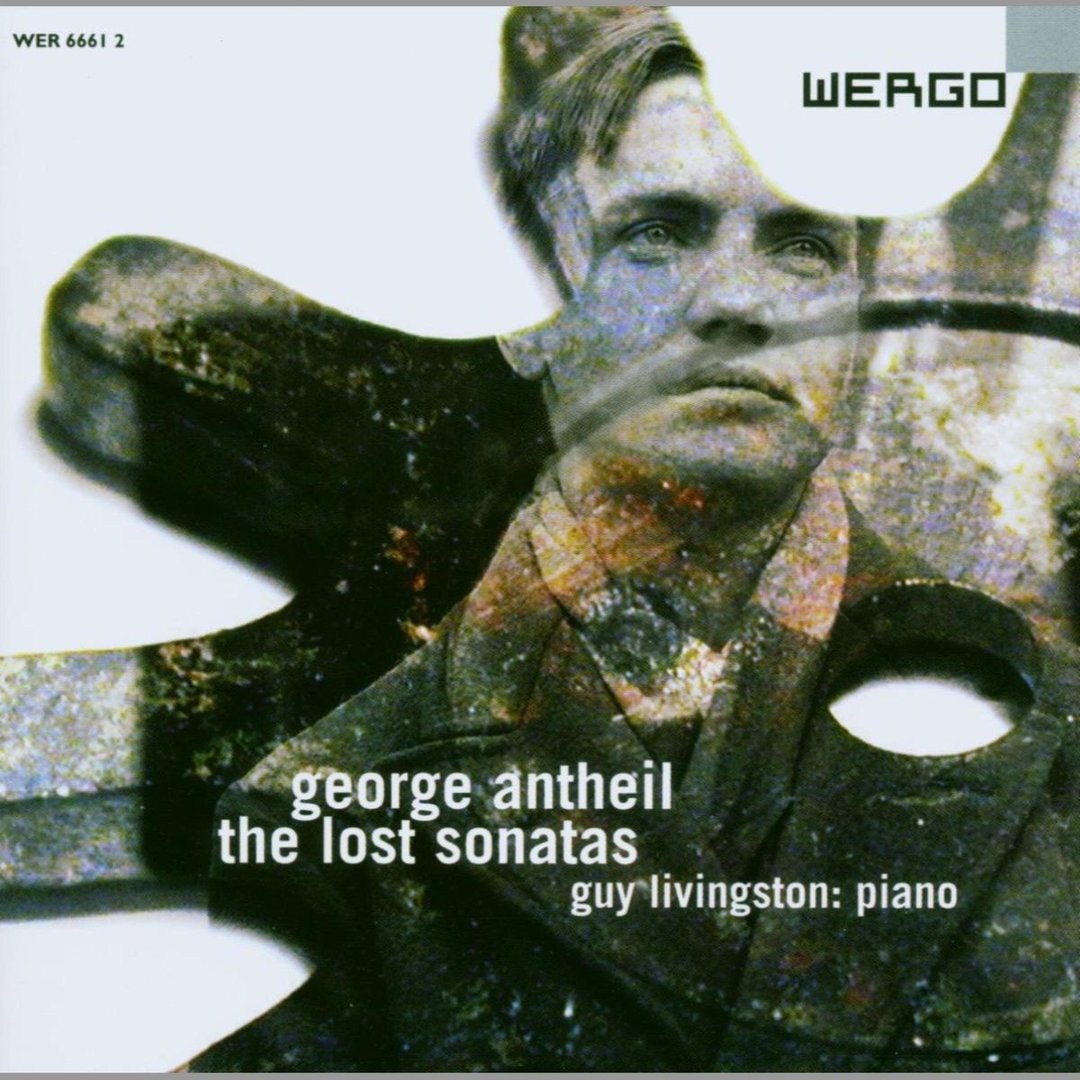
George Antheil
The Lost Sonatas
FormatCDLabelWergoGenreComposition
Arriving from the supplier: On backorder (ships as soon as it reaches us)
Tracked express shipping from Italy, no customs or import VAT in the EU. Shipping costs
The Lost Sonatas collects five piano sonatas by George Antheil, the "bad boy of music", brought to light by the pianist Guy Livingston. Three of them are first recordings: the Fifth Sonata (1950), the Woman Sonata (1923) and the Third Sonata (1947). They sit beside the Sonate Sauvage of 1923 and the Fourth Sonata of 1948.
Antheil was born in Trenton, New Jersey, on 8 July 1900 and died in New York on 12 February 1959. In 1922 a European tour launched him as an avant-garde pianist, and the following year he moved to Paris, where he befriended James Joyce and Ezra Pound. The premiere of his Ballet mécanique at the Théâtre des Champs-Élysées on 19 June 1926 caused a sensational scandal. From 1936 he lived in Hollywood and wrote some thirty film scores, while still composing concert music and operas.
Livingston, born in Tennessee and trained at Yale, the New England Conservatory and the Royal Conservatory of the Netherlands, also produced an Antheil Centennial Festival. He recorded the set in July 2003 at the Eglise de Saint-Marcel in Paris, on a Fazioli F-278, with Joël Perrot as recording engineer and artistic director. The New York Times has called Antheil a maverick composer of quirky works that brim over with character, and Livingston a pianist with a flair for modernism of all stripes.
The two works of 1923 belong to the Paris years. The Sonate Sauvage has three short movements, À la nègre, Serpents and Ivoire, in under nine minutes. The Woman Sonata moves from Woman (Languor) to a prestissimo Tree and a moderato Flower. The later sonatas, from the late 1940s, are larger: the Fourth runs Allegro giocoso, Andante, Vivo, the Third ends with a movement marked Diabolic, and the Fifth, almost nineteen minutes long, includes a minuet. Set side by side, they show how far Antheil's piano writing moved in a quarter of a century, from brief movements with evocative titles to three-movement forms with conventional tempo markings.
CD, Wergo WER 6661 2, released in 2003, 67 minutes, with booklet texts in English, French and German.
Release notes
Fifth Sonata 1950. Sonata Sauvage 1923. Woman Sonata 1923. Fourth Sonata 1948. Third Sonata 1947. Recordings: Eglise de Saint-Marcel, Paris, July 2003. World prèmiére recordings of tracks 1-3, 7-9 & 13-15. © + ℗ 2003 WERGO Manufactured in Austria · Printed in Germany
| Fifth Sonata | |||
| 1 | Andante / Allegro Molto | 7:06 | |
| 2 | Minuet | 5:16 | |
| 3 | Allegro | 6:18 | |
| Sonata Sauvage | |||
| 4 | A La Nègre | 3:39 | |
| 5 | Serpents | 3:59 | |
| 6 | Ivoire | 1:02 | |
| Woman Sonata | |||
| 7 | Woman (Languor) | 5:02 | |
| 8 | Tree (Prestissimo) | 0:27 | |
| 9 | Flower (Moderato) | 0:37 | |
| Fourth Sonata | |||
| 10 | Allegro Giocoso | 5:13 | |
| 11 | Andante | 5:41 | |
| 12 | Vivo | 3:33 | |
| Third Sonata | |||
| 13 | Allegro | 5:11 | |
| 14 | Adagio | 8:47 | |
| 15 | Diabolic "Cartoon" | 4:31 | |
- George Antheil
- Composed By
- Joël Perrot
- Engineer [Recording], Producer [Artistic Director]
- Emmanuel Bonnétat
- Liner Notes [French Translation]
- Marie Warburton
- Liner Notes [French Translation]
- Esther Dubielzig
- Liner Notes [German Translation]
- Morna Livingston
- Photography By
- Nikolaos Samaltanos
- Photography By
- Guy Livingston
- Piano [Fazioli F-278]
- Jean-Michel Daudon
- Technician [Piano]