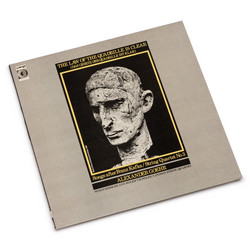
Symmetry Disorders Reach, op. 73 (2002), is a large cycle for solo piano by Alexander Goehr, played here by his former Cambridge pupil, the composer and pianist Huw Watkins. Its title and its frame of ideas come from W. H. Auden's New Year Letter, and the work uses models by Bach, Handel, Mozart and Schumann to explore the creative act.
Goehr, a British composer of German descent, was born in Berlin on 10 August 1932, brought up in England, and died in Cambridgeshire on 26 August 2024. Schott counts him among the leading musical figures in the UK, both as composer and as teacher. This recording is the result of a direct collaboration between teacher and pupil. Watkins recorded it on 20 and 21 December 2005 at the Jerusalem Music Centre, with Vadim Beili recording and editing. The liner notes are by Paul Griffiths.
The cycle is in two parts, of nine and six pieces. The first is a chain of short, sharply characterised pieces on old forms: a Prelude, two Inventions, a Capriccio, a Fughetta, a Chaconne, a Moto perpetuo, a Burlesque and a Metric Maze. The second part is built on larger spans: a Little Harmonic Labyrinth followed by its Double, an Air with its own Double, an Adagio of over six minutes, and a brief Vivo of barely a minute to close. The Schott text describes the method: the disorders of the imagination are arranged and extended into a kind of symmetry, while a symmetrical matrix is in turn spun out into luxuriant disorder.
The names of the movements point back to the models Schott mentions, the Baroque suite and its doubles, the invention, the chaconne, the perpetuum mobile. Auden's poem supplies the paradox of the title, a reach towards order that keeps producing disorder. The cycle lasts just over fifty minutes and is played here by one of his former Cambridge pupils, a composer in his own right, so the performance comes from inside the teaching relationship the cycle grew out of.
CD, Wergo WER 6692 2, released in 2007. Total running time 50'28".