sai-ji-ku is a shared album by the German composer Wilfried Jentzsch and the Japanese composer Hiromi Ishii, with three electroacoustic works by each. The title combines three Japanese words for colour, time and space, which sum up their common interest: shaping sounds by their timbre and moving them vividly through time and space.
Jentzsch, born in 1941, was a master student of Rudolf Wagner-Régeny and Paul Dessau at the Akademie der Künste in Berlin, studied electronic music with H. U. Humpert in Cologne and took a doctorate in music aesthetics with Iannis Xenakis at the Sorbonne. From 1976 to 1981 he worked on digital sound synthesis at IRCAM and CEMAMu in Paris, and in 1993 he became head of the electronic studio of the Dresden Musikhochschule. Ishii, born in 1957, studied there with him from 1998, after composition studies with Tsuneya Tanabe in Tokyo, and in 2006 completed a doctorate at City University, London. Her thesis argued that electroacoustic means suit Japanese tradition because its most developed music is dominated by timbre. All six works have an intercultural link to Asia: Ishii's relate to her Japanese origins, Jentzsch's to Indonesia and China, where his interest goes back to a study trip on gamelan scales and timbres in Java and Bali.
Jentzsch's Huai bieh (2012/13), "desire and farewell", is inspired by Kun opera, and its central idea is the transformation of a melody in time, timbre and space. His Paysages Y 757 (2013/14) and Dream of B (2007) complete his part. Ishii's Ginn-Tokio 2006 (2006/13) starts from the double-layered structure and harsh contrasts of Tokyo and asks how tradition and modernity, two very different worlds, can exist side by side. Her Ryojinfu (2013) and Shinra (2011) are the other two pieces.
The works were projected in a Klangdom, a dome of 47 loudspeakers (43.4) placed spherically above the audience, using the spatialisation software Zirkonium, so that sounds can move freely in every direction and at every speed. The performances were recorded with dummy head technology to keep the spatial information on a stereo disc.
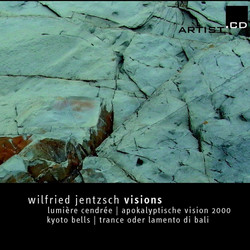
CD, total running time 63'57", released in 2017 by artist.cd / Wergo as ARTS 8121 2.