Ensemble Musikfabrik
Schattenspiele
FormatCDLabelWergoGenreComposition
Arriving from the supplier: On backorder (ships as soon as it reaches us)
Tracked express shipping from Italy, no customs or import VAT in the EU. Shipping costs
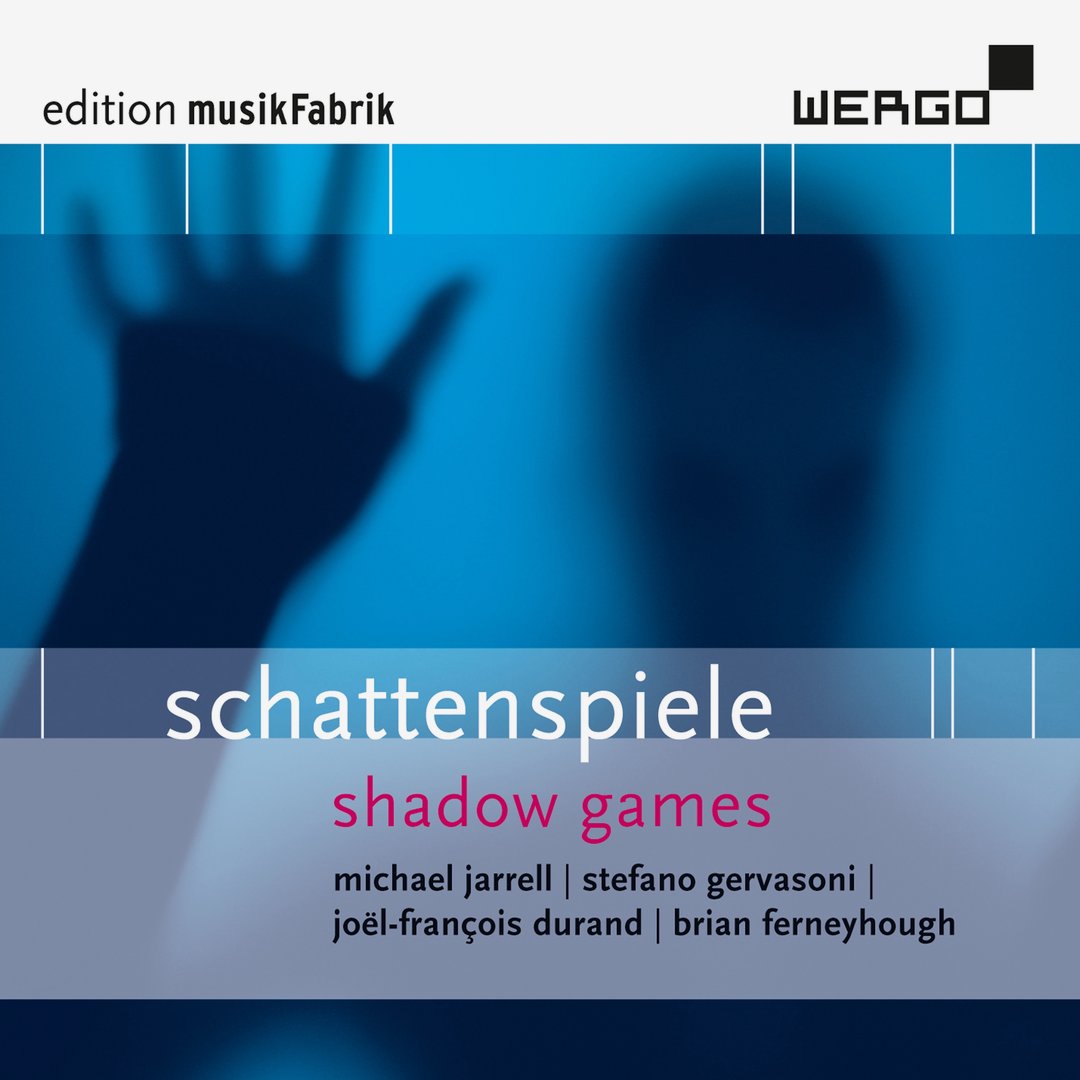
The fourth volume of the Edition Musikfabrik is a foray into the land of shadows and melancholy. Four works for soloist and ensemble play with light and shadow, and each rethinks the relation between the solo part and the group. Ensemble Musikfabrik plays music by Michael Jarrell, Stefano Gervasoni, Joël-François Durand and Brian Ferneyhough, with four soloists.
The soloists are violinist Hae-Sun Kang, double bassist Michael Tiepold, flutist Helen Bledsoe and the speaker Omar Ebrahim. Diego Masson conducts the Jarrell, Etienne Siebens the Gervasoni and James Wood the Durand and Ferneyhough. The recordings are productions of Westdeutscher Rundfunk, with booklet notes by Stefan Fricke. Jarrell was born in Geneva in 1958 and studied with Klaus Huber and Ferneyhough in Freiburg. Durand, born in Orléans in 1954, has taught at the University of Washington since 1991. Gervasoni was born in 1962 and Ferneyhough in 1943.
Jarrell's prisme / incidences II refracts the solo line through the ensemble as through a prism. It derives from his violin concerto ... prisme / incidences ... of 1998, which Kang premiered with orchestra in Paris. Gervasoni's Far niente (1998, revised 2007), for double bass and seventeen instruments, has two parts, "Alba" and "Notturno". It is only on the surface about idleness: its nocturnal music gathers odd sound shapes until the alarm goes off. Tiepold and Musikfabrik played the revised version at WDR in 2007. Durand's Ombre/Miroir (2004) for flute and fourteen instruments takes an early-morning look in the mirror and finds shadowy creatures there too. Ferneyhough's Seven Tableaux Vivants Representing the Angel of History as Melancholia (2003) is the sixth scene of his opera Shadowtime, on the life of Walter Benjamin. Here Benjamin's angel of history speaks through verses by the poet Charles Bernstein, over an ensemble with three bass clarinets.
The programme starts from black bile, the humour said to cause gloom, which as melancholia became an allegory of the artistic imagination. Ferneyhough's scene was commissioned by the Ensemble intercontemporain and the Musée d'Orsay and premiered in Paris in January 2004.
CD, Wergo WER 6854 2, Edition Musikfabrik vol. 4, released in 2010 (total time 58'29"), with a 26-page booklet.
Release notes
Jewel case 26-page booklet
| 1 | ... Prisme / Incidences II ... | 14:28 | |
| 2 | Far Niente | 15:52 | |
| 3 | Ombre/Miroir | 14:04 | |
| 4 | Shadowtime VI; Seven Tableaux Vivants Representing The Angel Of History As Melancholia | 13:41 |
- MusikFabrik
- Ensemble
- Stefan Fricke
- Liner Notes