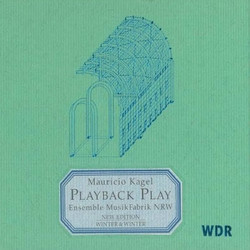
Sterben (Dying) is a volume of the Edition Musikfabrik built around the oldest question: what happens after death. Three composers answer it in very different ways, and all three works appear here in their first recordings. The longest of them is the last, unfinished song cycle of Mauricio Kagel, on the final poems of Heinrich Heine.
The Cologne Ensemble Musikfabrik plays under three conductors: Marcus Creed in the piece by Francesco Filidei, Otto Tausk in the work by Michael Beil, and Emilio Pomàrico in the Kagel, with the tenor Markus Brutscher. The recordings are a production of Westdeutscher Rundfunk Köln from the series Musikfabrik im WDR. Filidei, born in Pisa in 1973, is an organist as well as a composer and trained in Florence and Paris. Beil has taught electronic music at the Cologne Hochschule für Musik und Tanz since 2007, and his work combines instruments, electronics and video.
For Filidei music and death are always connected: of the three instruments man found to explore life, philosophy, religion and art, he finds music the most effective, because it works with time. His Finito ogni gesto (2010) opens the disc. Beil's Black Jack, for 17 instruments and electronics, plays with the relation between sound and image, playback and action, with silence and repetition. It ends in a powerful march where the virtual and the real stand against each other. Kagel's In der Matratzengruft (2007-08) for tenor and ensemble takes its title from Heine's own name for the sickbed of his last years, the "mattress grave". In fifteen sections Kagel regroups the soloistic ensemble again and again, mixing a new colour for each.
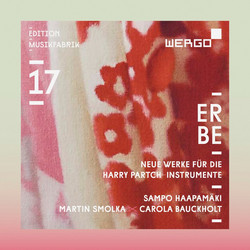
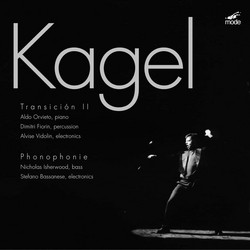
Kagel called the piece "a musical parable of Heine's fragmented existence", where fragments of fragments follow one another, sometimes at once. Born in Buenos Aires in 1931, he settled in Cologne in 1957 and died there in September 2008, before he could finish the cycle. The cover and booklet poster reproduce Gerhard Richter's painting Blumen (1994); Richter has sat on the ensemble's board of trustees since 2009.
CD in digipak with fold-out poster, Wergo WER 6863 2, released in 2016 in the Edition Musikfabrik (67'38").