Sofia Gubaidulina
Sieben Worte / In Croce
FormatCDLabelWergoGenreComposition
Arriving from the supplier: On backorder (ships as soon as it reaches us)
Tracked express shipping from Italy, no customs or import VAT in the EU. Shipping costs
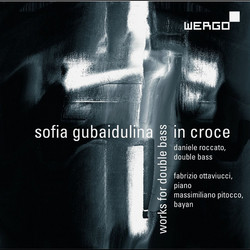
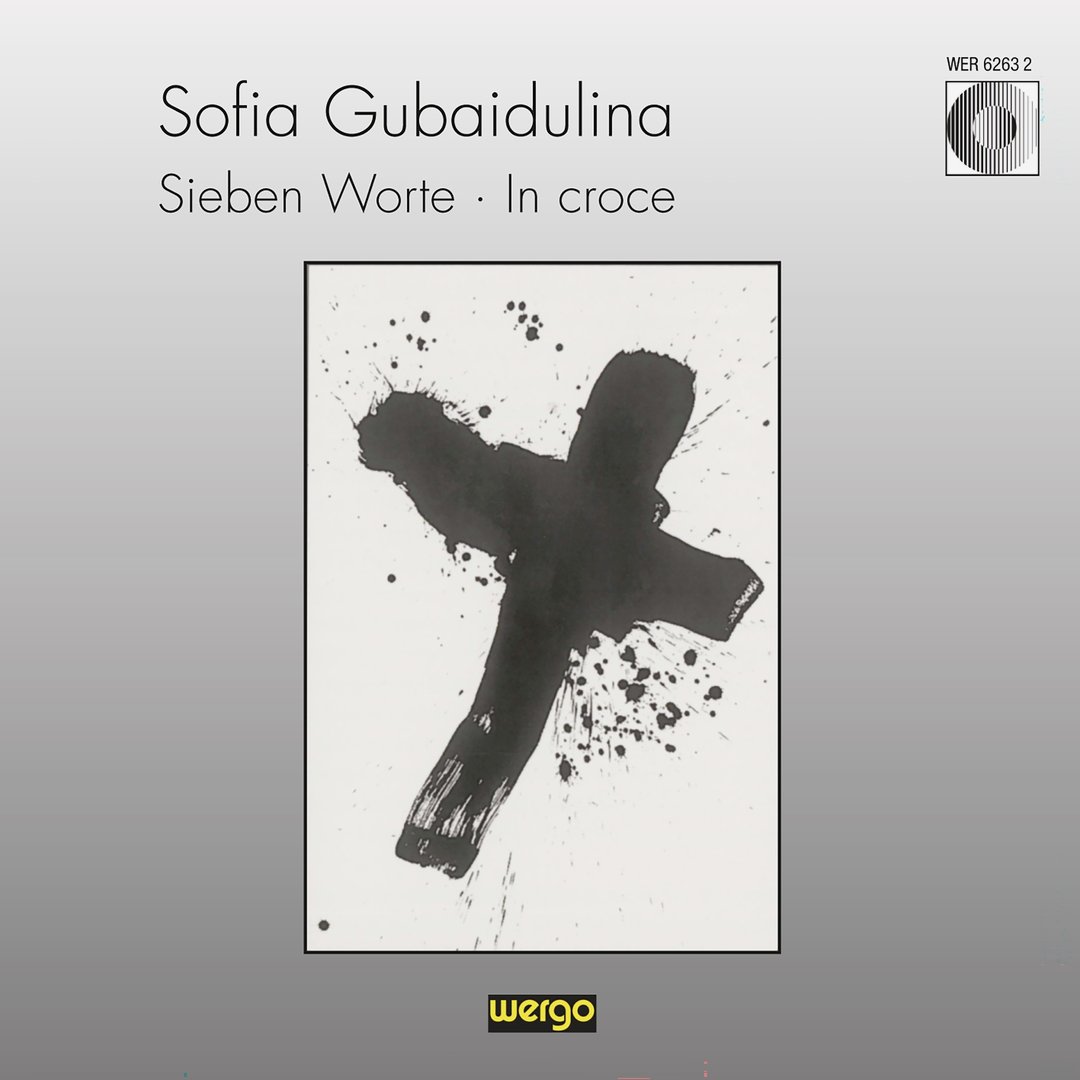
This disc brings together two works in which Sofia Gubaidulina turns the image of the cross into musical form: Sieben Worte (Seven Words) for cello, accordion and strings, written in 1982, and In croce for cello and accordion, her own arrangement of a piece originally written for cello and organ. Both are built on a simple spatial idea, and both make it audible with great directness.
Gubaidulina was born in Chistopol, in the Tatar republic, in 1931, trained in Kazan and Moscow, and had no easy career in the Soviet Union. In 1962 a critic praised her technique but belittled her intellectual position, and she held to her course regardless. Her music began to be played in the West in the mid-1960s, and from the 1980s she could travel regularly; she later settled near Hamburg, where she died in March 2025. The soloists here are cellist Julius Berger and accordionist Stefan Hussong, joined in Sieben Worte by the Kammerorchester Diagonal under Florian Rosensteiner. Jürg Erni produced the recording, with Charles Suter and Jürg Jecklin as recording directors.
Sieben Worte follows the seven last words of Christ in seven movements and refers to the cantata by Heinrich Schütz. The fourth movement, "Mein Gott, mein Gott, warum hast du mich verlassen?", is the centre of the whole work. In the movements that follow the cellist moves the bow step by step towards the bridge until, in the seventh, he plays on its far side ("dietro ponticello"), the musical sign of Christ's transformation. At that moment the tutti strings, spread over seven octaves, sound the symbol of the cross. In croce (1979, arranged in 1992) draws the same figure with two lines: one instrument starts in the highest register, the other in the lowest, they move towards each other, mix at a certain point and separate again with their roles exchanged. Here the accordion takes over the part first written for organ.
Gubaidulina said she understood religion as "religio", the re-establishment of a connection or unity that is increasingly lost in the "staccato of life". Composing was for her a religious act, and every work a new path towards that connection. In these two pieces the idea is not illustrated from outside: the cross is traced by the meeting of registers and by the position of the bow on the string.
CD, Wergo WER 6263 2, released in 1994 (total time 54'54").
| Sieben Worte - Für Violoncello, Akkordeon Und Streicher (1982) | |||
| 1 | Vater, Vergib Ihnen, Denn Sie Wissen Nicht, Was Sie Tun. | 5:11 | |
| 2 | Weib, Siehe, Das Ist Dein Sohn. - Siehe, Das Ist Deine Mutter. | 4:02 | |
| 3 | Wahrlich, Ich Sage Dir: Heute Wirst Du Mit Mir Im Paradiese Sein. | 4:07 | |
| 4 | Mein Gott, Mein Gott, Warum Hast Du Mich Verlassen? | 9:42 | |
| 5 | Mich Dürstet. | 5:53 | |
| 6 | Es Ist Vollbracht. | 3:16 | |
| 7 | Vater, Ich Befehle Meinen Geist In Deine Hände. | 6:03 | |
| - | |||
| 8 | In Croce - Für Violoncello Und Akkordeon (1979/92) (Nach Der Originalfassung Für Violoncello Und Orgel) | 16:37 | |
- Stefan Hussong
- Accordion
- Winfried Muthesius
- Artwork
- Julius Berger
- Cello
- Sofia Gubaidulina
- Composed By
- Florian Rosensteiner
- Conductor (1 to 7)
- Kammerorchester Diagonal
- Orchestra (1 to 7)
- Jürg Erni
- Producer
- Charles Suter
- Sound Designer [Musikregie]
- Jürg Jecklin
- Sound Designer [Musikregie]