Sofia Gubaidulina, Elsbeth Moser, Boris Pergamenschikow, Münchener Kammerorchester, Christoph Poppen
Sofia Gubaidulina
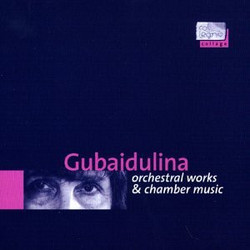
This was the first ECM album devoted to Sofia Gubaidulina, born in 1931 in the Tatar republic of the Soviet Union. At its centre is Seven Words (1982) for cello, bayan and strings, a purely instrumental meditation on Christ's last words from the cross. Two solo works complete the programme: the Ten Preludes for cello and De Profundis for bayan. In all three, Gubaidulina's ear for colour and her pairing of a folk instrument, the Russian button accordion, with concert instruments come to the fore.
The recording was made in January 2001 at the Himmelfahrtskirche in Munich-Sendling and released in February 2002. Elsbeth Moser plays bayan and Boris Pergamenschikow cello, with the Münchener Kammerorchester conducted by Christoph Poppen. Manfred Eicher produced the album, Stephan Schellmann was the engineer, and Hermann Conen wrote the booklet essay. None of the three works was new to disc, since the original dedicatees, Vladimir Tonkha and Friedrich Lips, had recorded them before.
Seven Words has seven slow movements, each titled after one of the sayings, from Vater, vergib ihnen to Vater, ich befehle meinen Geist in deine Hände. Like Haydn's setting of the same words, it uses no voices, a point made by Stephen Pettitt in the Sunday Times. Soviet censors made Gubaidulina drop "of Our Saviour on the Cross" from the title. Cello and bayan answer each other above a string orchestra that writers compared to a church choir. The Ten Preludes (1974, later revised) began as teaching pieces, each named after a way of playing, ending with senza arco, senza pizzicato. De Profundis (1978) answers the psalm with breathing chords, clusters and noise from the bayan.
In BBC Music Magazine, Calum MacDonald called the three works "essential listening for anyone seeking to understand the ardent, mystical unconventional spirit of Sofia Gubaidulina." Ivan Moody, writing in International Record Review, said that Moser and Pergamenschikow "play as though their lives depended on it." In The Wire, Philip Clark traced De Profundis back to Gubaidulina's years in the improvisation group Astreya, and Die Zeit called the production exemplary in sound and interpretation.
This is the CD edition of ECM New Series 1775, first released in 2002.