Milica Djordjević
The Death of the Star-Knower
FormatCDLabelWergoGenreComposition
Arriving from the supplier: On backorder (ships as soon as it reaches us)
Tracked express shipping from Italy, no customs or import VAT in the EU. Shipping costs
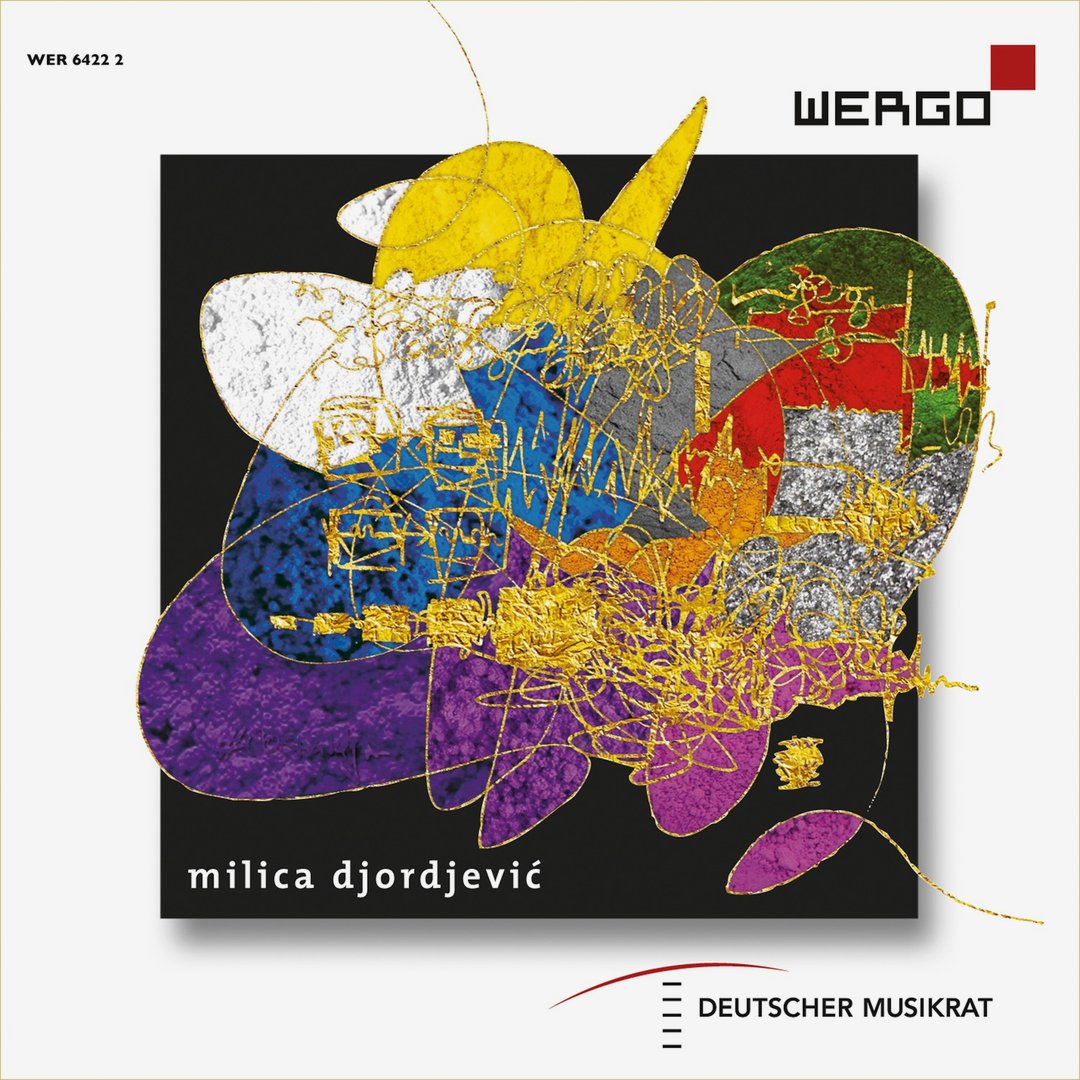
The Death of the Star-Knower is the first portrait CD of the Serbian composer Milica Djordjević, seven works from 2008 to 2015 in the Edition Zeitgenössische Musik. Her pieces are explorations of sound, close observations and dissections of a material pushed to its limit. In 2017 the disc received the Preis der deutschen Schallplattenkritik, the German Record Critics' Award.
Djordjević received the Belmont Prize in 2015 and the Ernst von Siemens Composers' Prize in 2016. Every piece here was recorded especially for the CD at the Deutschlandfunk Kammermusiksaal in Cologne, on several dates between March and December 2016, with Frank Kämpfer as producer. The performers include the Arditti Quartet, the accordionist Teodoro Anzellotti and Ensemble Musikfabrik conducted by Johannes Schöllhorn. Soloists include the trumpeter Marco Blaauw, the double bassist Florentin Ginot, the cellist Francesco Dillon and the mezzo-soprano Truike van der Poel.
The title work, The Death of the Star-Knower – petrified echoes of an epitaph in a kicked crystal of time I&II (2008/09), is for string quartet and played by the Arditti. At almost sixteen minutes it is the longest piece on the disc. Phosphorescence (2014) is for horn, trumpet and bass trombone, played by Christine Chapman, Blaauw and Bruce Collings. Anzellotti plays the solo ... würde man denken: Sterne (2015). Manje te u majke groze (2011), for soprano, bass clarinet, accordion, violin, viola and cello, sets van der Poel against the ensemble. The disc ends with FAIL (2010), for cello and live electronics, played by Dillon.
In the booklet Barbara Eckle describes the method. Djordjević develops a material component "further and further in an increasingly large, loud and dense wave", distorting and multiplying it until it implodes. Then the rupture comes suddenly, "as if the plug of an electronic appliance were ripped from a wall socket". An interdisciplinary outlook, rooted in a varied aesthetic background, also shapes the music. The resulting figures act on the psyche and the intellect at once. How to evade? (2011) for oboe and violin and Do you know how to bark? (2010/11) for solo double bass complete the set.
CD with a 36-page booklet, 67 minutes, WER 6422 2, released in 2017 in the German Music Council's Edition Zeitgenössische Musik, a co-production with Deutschlandfunk.
Release notes
Recorded 11. - 13., 18. - 19. March, 23. April, 1. December 2016, Deutschlandfunk Kammermusiksaal, Köln © & ℗ 2017 WERGO, a division of Schott Music & Media GmbH, Mainz, Germany. Manufactured and printed in Germany. Made in the EU. Jewel case, clear tray, 36-page booklet.
| 1 | The Death Of The Star-Knower – Petrified Echoes Of An Epitaph In A Kicked Crystal Of Time I&II, Für Streichquartett (2008/09) | 15:51 | |
| 2 | Phosphorescence, Für Horn, Trompete Und Bassposaune (2014) | 11:09 | |
| 3 | … Würde Man Denken: Sterne, Für Akkordeon Solo (2015) | 9:30 | |
| 4 | How To Evade? Für Oboe Und Violine (2011) | 8:46 | |
| 5 | Do You Know How To Bark?! Non-Communication For Solo Contrabass Ver. 2.1.1 (2010/11) | 5:44 | |
| 6 | Manje Te U Majke Groze, Für Sopran, Bassklarinette, Akkordeon, Violine, Viola Und Violoncello (2011) | 7:55 | |
| 7 | Fail, Für Violoncello Und Live-Elektronik (2010) | 6:59 |
- Milica Djordjević
- Composed By
- Ernst Hartmann
- Engineer
- Gunther Rose
- Engineer
- Hendrik Manook
- Engineer
- Holger Urbach
- Engineer
- Michael Morawietz
- Engineer
- Stephan Schmidt
- Engineer
- Wolfgang Rixius
- Engineer
- Frank Kämpfer
- Producer