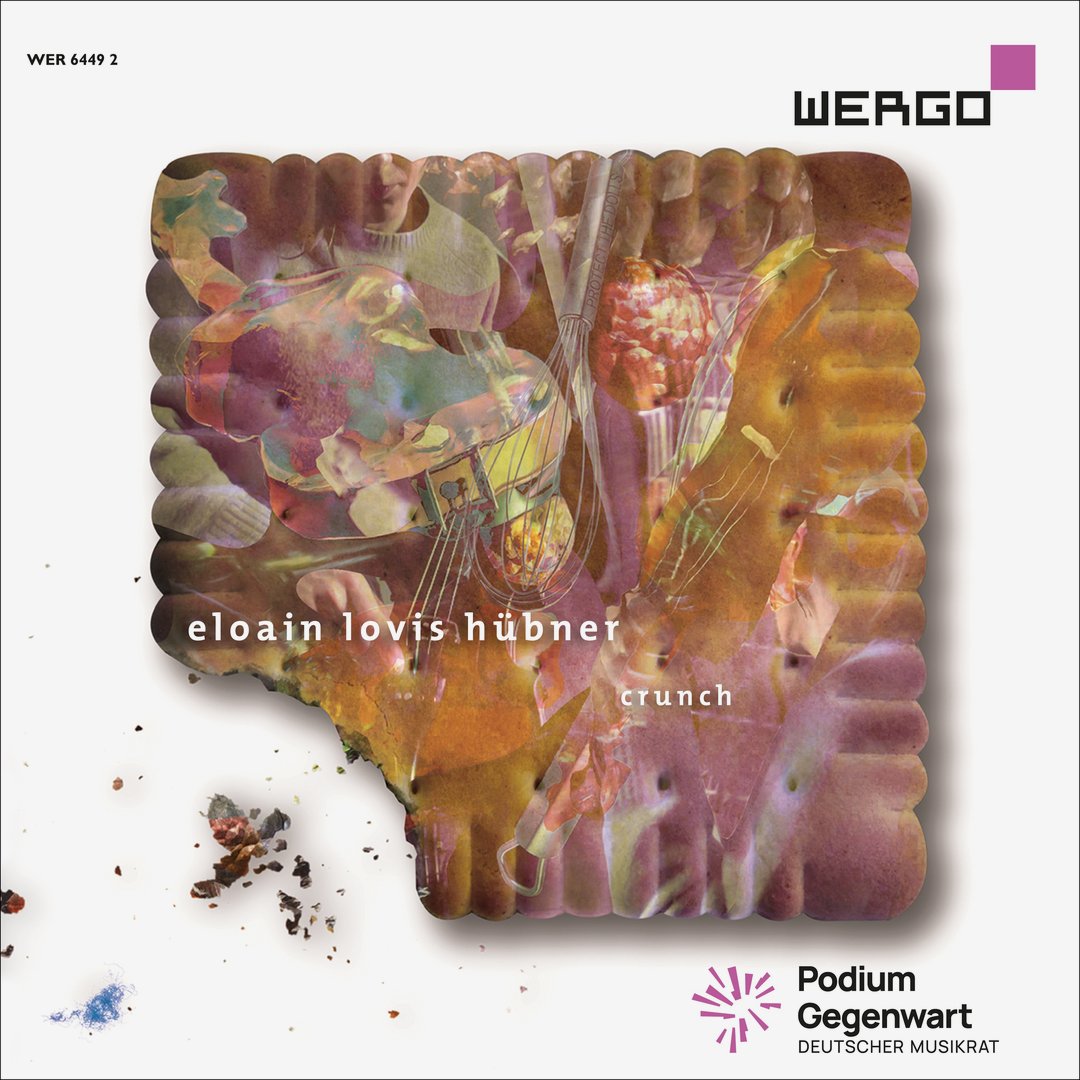
Eloain Lovis Hübner
Crunch
FormatCDLabelWergoGenreComposition
Arriving from the supplier: On backorder (ships as soon as it reaches us)
Tracked express shipping from Italy, no customs or import VAT in the EU. Shipping costs
In the music of Eloain Lovis Hübner things crunch, rustle, whisper, rattle and bubble. Extended techniques, preparations and everyday materials produce an apparently endless variety of sounds. Crunch, Hübner's portrait CD, centres on two series of works and adds a single vocal piece. Sound is treated here not as fixed material but as a state.
Hübner, born in 1993, studied composition in Hanover, Cologne, Dresden and Oslo and applied theatre studies in Giessen, and works in collectives such as the paranormal φeer group and the music-theatre group The Navidsons. Prizes include the composition prize of the City of Stuttgart (2018), the Bremen Composers' Prize (2020) and the Deutscher Musikautor:innenpreis (2022). Six groups perform. The Schallfeld Ensemble plays under Leonhard Garms, followed by the Spółdzielnia Muzyczna Contemporary Ensemble, AuditivVokal Dresden under Olaf Katzer, airborne extended, the Arditti Quartet and the trio Lange//Berweck//Lorenz. The first piece was produced by Österreichischer Rundfunk (Ö1) and the second by the ensemble itself. The rest are coproductions of Deutschlandfunk and the German Music Council, produced by Frank Kämpfer. The booklet text is by Sophie Emilie Beha.
crunch modes 1.0 and crunch modes 3.0, both for amplified ensemble with sound objects, the first with live electronics and the second with audio playback, show what is typical of Hübner. They zoom between micro- and macrocosm, between structure and loss of control, accumulation and decay, radicalism and delicacy. Trauma und Zwischenraum (Trauma and Interstice) was written under the influence of the coronavirus pandemic and uses three very different line-ups. In the first part airborne extended play recorders, flutes, prepared harp and prepared harpsichord. In the second, the Arditti Quartet swap their bows for whisks, corks and toothbrushes. The third part uses hybrid sound bodies such as accordion with an effects unit, or a Korg MS-20 Mini with electric guitar.
In [untitled], for six voices and playback, AuditivVokal Dresden works with nonsense speech, noise imitation and film language, referring to the airport scene of Casablanca. Hübner was composer in residence with the choir in 2023. Beha describes the sound as a living relationship between bodies, instrumental, vocal or electronic. The CD was nominated for the Quarterly Critics' Choice 3/2026 of the German Record Critics' Award.
CD, Wergo WER 6449 2, released in 2026 in the German Music Council's Edition Zeitgenössische Musik, running 75 minutes.
| 1 | Crunch Modes 1.0 | 10:28 | |
| 2 | Crunch Modes 3.0 | 12:42 | |
| 3 | [Untitled] | 8:46 | |
| 4 | Trauma und Zwischenraum 1 | 14:29 | |
| 5 | Trauma und Zwischenraum 2 | 11:40 | |
| 6 | Trauma und Zwischenraum 3 | 16:37 |
- Deutscher Musikrat gemeinnützige Projektgesellschaft mbH
- Co-producer (3 - 6)
- Deutschlandfunk
- Co-producer (3 - 6)
- Gunter Schneider
- Engineer [Aufnahmeleiter] (1)
- Michael Kogler
- Engineer [Tonmeister] (1)
- Robert F. Schneider
- Engineer [Tonmeister] (3 - 6), Mixed By (2)
- Michał Warmusz
- Engineer [Tontechnik] (2)
- Sophie Emilie Beha
- Liner Notes
- Frank Kämpfer
- Producer (3 - 6)
- Spółdzielnia Muzyczna Contemporary Ensemble
- Producer (2)
- Österreichischer Rundfunk
- Producer (1)
- Olaf Wegener
- Project Manager
- Liz Hurst
- Translated By