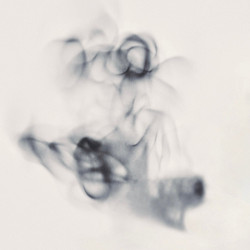
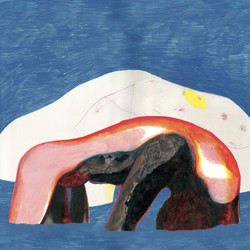
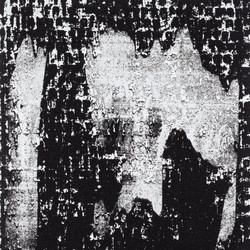
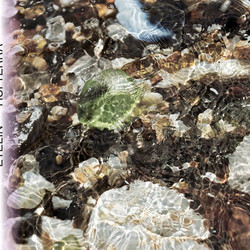
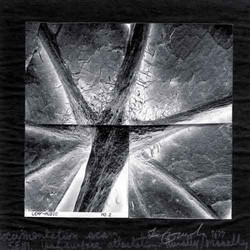
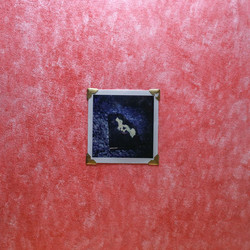
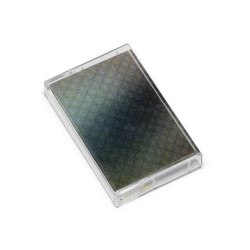
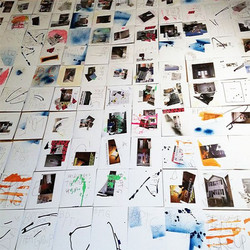
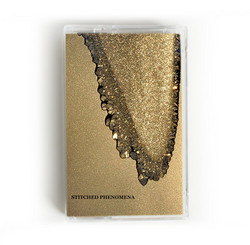
*Edition of 200 with full color jacket and two-sided insert with text by the artist. Mastering by Giuseppe Ielasi, photography by Yushi Arimura and Keith Freund, design by Josh Mason. * A chair tied to a faucet by a length of rope: this was the simple, inscrutable image that stayed with Alex Cobb after a Zen Buddhist meditation retreat. A short poem, written spontaneously during intensive zazen, tried to hold the experience in words. The Chair and the Faucet, released under Cobb’s Etelin project, attempts a more elusive translation - not an illustration of meditation, but a musical realization of its particular state of attention. The result is a probing, 33‑minute work of tonal curiosity in which duration, restraint and slight instability become the composition’s real instruments.
Cobb made the record exclusively with a Serge Modular system, whose open design allows audio signals and control voltages to be treated as part of the same material field. This is synthesis stripped of the familiar hierarchy between command and response: a voltage may govern a sound, become a sound, or drift somewhere between the two. That flexibility makes the Serge especially suited to Cobb’s purposes. Rather than bending electricity toward a preordained gesture, he listens for what occurs when a process is allowed to persist - its small asymmetries, accidental collisions, moments of inelegance and flashes of unexpected harmonic grace. The signal path remains almost entirely dry, with reverb appearing only in carefully chosen, minimal instances; sound arrives with little cosmetic shelter, exposed in its grain and pressure.
The album draws inspiration from rudimentary early electronic music and the bracing proposition that a piece of music might consist only of a function generator cycling for a while. That apparent modesty is fundamental. Cobb does not decorate a process to make it feel eventful, nor rush it toward a climax. He lets tones remain in place long enough for their internal activity to become apparent: microtonal drones phase against one another, closely tuned pitches create beating particles, and harmonic fields alter in ways that are felt before they can be easily named. Silence is not a backdrop but an active pressure around the sounds, making every new fluctuation register with unusual force.
As The Chair and the Faucet progresses, linearity evaporates. The Serge’s emissions expand sideways and diagonally, forming paths that evolve without settling into repetition and may end without fully resolving. Spartan textures introduced at the outset gather diffuse strata; layers adhere, desynchronize and recombine. A thin high‑frequency filament may suddenly reveal a low, bodily undertow. A drone that appears static becomes porous, its internal pulse shifting with the listener’s position in the room. Cobb is particularly attentive to spatial disparity: turn your head, change the temperature, move a few steps from the speakers, and the frequency spectrum seems to recast itself. The record’s psychoacoustic effects are not ornamental tricks but part of its core inquiry into perception as a moving target.
The title image offers a useful way into this music. The chair suggests the body at rest, the faucet the endless flow of phenomena; the rope is the inexplicable line binding the two. Cobb’s album neither unties that knot nor gives it a symbolic explanation. It stays with the relation - object to object, attention to sound, control to contingency - until its strangeness becomes fertile. Like zazen itself, the listening asks for neither transcendence nor interpretation so much as an alert willingness to remain with what is happening.
Mastering by Giuseppe Ielasi preserves the delicacy of Cobb’s harmonic relationships and the full force of their low‑level movement. Photography by Yushi Arimura and Keith Freund, with design by Josh Mason, extends the project’s fascination with material presence: surfaces, distances, objects and the quiet meanings that accrue around them. The Chair and the Faucet opens another distinctive chapter in Cobb’s prolific catalog, but it also stands alone as a startling study in wavering harmonic perspective - a record that makes electronic sound feel less programmed than patiently discovered.