Wilfried Jentzsch
Visions
FormatCDLabelWergoGenreComposition
Arriving from the supplier (ships as soon as it reaches us)
Tracked express shipping from Italy, no customs or import VAT in the EU. Shipping costs
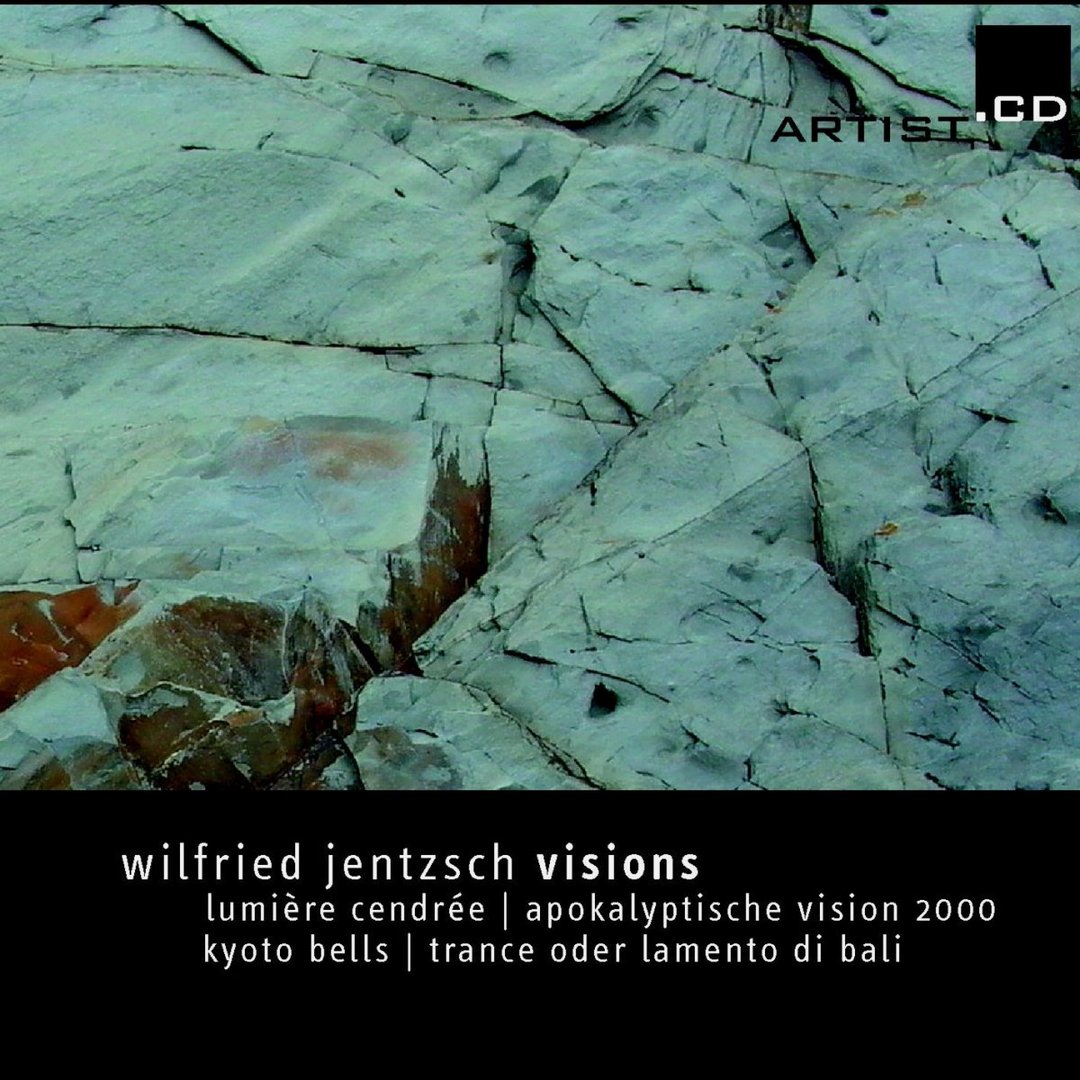
Visions collects four electroacoustic works by the German composer Wilfried Jentzsch, written between 1994 and 2003. Two of them draw on voices, a choral setting of the Book of Revelation and a granular piece built on a Tibetan monk's voice, and two travel to Asia, through temple bells from Kyoto and gamelan recorded in Java.
Jentzsch, born in 1941, is a composer from the former GDR who used a stay at the composition seminar in Boswil to leave for the West. He later taught electroacoustic composition in Dresden, where Hiromi Ishii was among his postgraduate students. The pieces here were commissioned by the Institut International de Musique Electroacoustique de Bourges, the Dresden Centre for Contemporary Music and for the 1200th anniversary of Kyoto. The choral work was written at the suggestion of R. Kreile, cantor of the Dresdner Kreuzchor, who premiered it with his choristers. Jentzsch also wrote the liner notes, in German and English, which explain the sound sources of each piece.
Lumière cendrée (2002), whose title means earthshine, the light of the Earth reflected on the Moon, uses a Tibetan singing bowl, a stone sculpture by Elmar Daucher, a Tibetan monk's voice and a treble from the Kreuzchor. Most of the transformations were made with granular synthesis in Max/MSP, and the work opened the Synthèse festival in Bourges on 31 May 2002. Apokalyptische Vision 2000, for choir, narrator and electronic sounds, sets texts from Revelation and was recorded at its first performance in the Dresden Kreuzkirche on 7 October 2000. At almost 27 minutes it is the centre of the disc.
Kyoto Bells (1994) is built from four bells of different sizes, a work of light, resonant sounds first heard in Kyoto on 4 December 1994. Trance oder Lamento di Bali (2003) uses a gamelan ensemble that Jentzsch recorded in October 2002 in the Kraton, the Sultan's palace of Yogyakarta, and was premiered at the ZKM Centre for Art and Media in Karlsruhe on 13 November 2004.
CD, total running time 65'32", released in 2004 by artist.cd / Wergo as ARTS 8105 2, with German and English liner notes.
Release notes
"Lumière Cendrée" composed 2002. Sound sources: Tibetan singing bowl, stone sculpture by Elmar Daucher, Tibetan monk voice, treble boy's voice from Dresdner Kreuzchor. Most of the sonic transformations were conducted using the Granular Synthesis in Max/MASP. Commissioned by Institut International de Musique Electroacoustique de Bourges (IMEB), premiered 31st May 2002 as part of the opening concert of the festival "Synthèse" in Bourges. "Apokalyptische Vision 2000" composed 2000 for choir,…
| 1 | Lumière Cendrée | 14:23 | |
| 2 | Apokalyptische Vision 2000 | 26:41 | |
| 3 | Kyoto Bells | 10:51 | |
| 4 | Trance Oder Lamento Di Bali | 13:34 |
- Wilfried Jentzsch
- Composed By, Liner Notes