Jazz /

Convergence: Live In China
On Convergence: Live In China, William Hooker and John King turn a Shenzhen stage into a pressure chamber, stretching one unbroken hour of drums and guitar from whispering tension to volcanic release in a charged act of real‑time communication.

Klotski
On Klotski, Lao Dan Quartet throws tenor, bamboo flute and suona into a Chicago crucible, where Mabel Kwan, Joshua Abrams and Michael Zerang keep reshaping time and texture until free jazz feels like a sliding puzzle in permanent motion.

Four Ways
On Four Ways, Roscoe Mitchell joins Stephen Rush’s shape-shifting Yuganaut trio for an electrically unstable encounter, where reeds, synths and oddball acoustics melt into one long, multi-hued improvising organism.

Celebrating Fred Anderson
On Celebrating Fred Anderson, Roscoe Mitchell honors a fellow Chicago giant with a live quartet that turns remembrance into motion, weaving Fred’s themes and Mitchell’s originals into long, tensile arcs of chant, swing and open-form ritual.

Before There Was Sound
On Before There Was Sound, Roscoe Mitchell’s 1965 quartet with Fred Berry, Malachi Favors and Alvin Fielder captures the AACM language in embryo: sharp themes, free rhythm and a restless sense of form already pushing past hard‑bop borders.

Old / Quartet Sessions
On Old/Quartet Sessions, Roscoe Mitchell’s 1967 Art Ensemble - with Lester Bowie, Malachi Favors and Phillip Wilson - appears in raw formation, sketching the grammar that would soon detonate as one of free music’s most inventive bands.

L-R-G / The Maze / S II Examples
On LRG/The Maze/S II Examples, Roscoe Mitchell frames three radically different constructions - a lucid brass-and-reeds trio, a labyrinthine percussion octet and a stark soprano solo - as parallel studies in space, timbre and compositional intelligence.

Nonaah
On Nonaah, Roscoe Mitchell turns the alto saxophone into a fault line, setting stark solos, prickly duets and dense small‑group pieces against one another to test how far a single composition and a single sound can be stretched.

Independent / Interdependent
On Independent / Interdependent, Savina Yannatou, Gonçalo Almeida and Costis Drygianakis turn a live trio into a dark, hovering organism, where voice, double bass and electronics circle each other in tense, shifting proximity, testing how far independence can stretch without breaking connection.

Mushin
On Mushin, Susana Santos Silva and Vasco Trilla strip trumpet and percussion down to pure responsiveness, letting sound arise and vanish like breath in a Zen exercise, where every gesture feels both unpremeditated and utterly focused.

Collective Heliophobic Dream
Suncuts emerged in 2023 from the earlier project Teufelskeller, originally founded by Anton Ponomarev in Moscow. Teufelskeller was invited to perform at the Xciting Festival in Stuttgart but due to various serious reasons the bass player and drummer were unable to go. Ponomarev brought in Swiss drummer Maxime Hänsenberger and Brazilian bassist Felipe Zenicola as replacement musicians. Both integrated quickly, and the new line-up performed the scheduled concerts. Although the three musicians had …
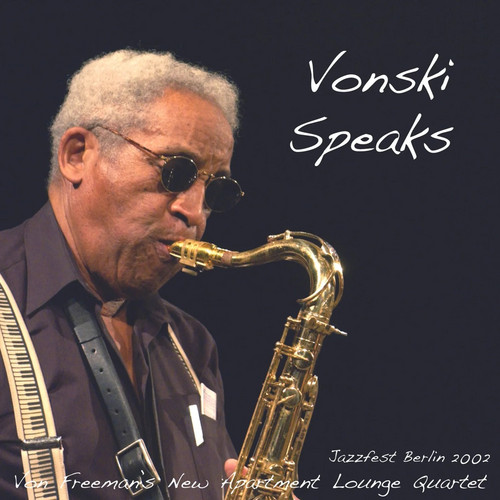
Vonski Speaks
On Vonski Speaks, Von Freeman stretches out with his New Apartment Lounge Quartet at Jazzfest Berlin 2002, turning four long pieces into a swaggering, late‑career testimony to Chicago grit, club intimacy and unforced authority.
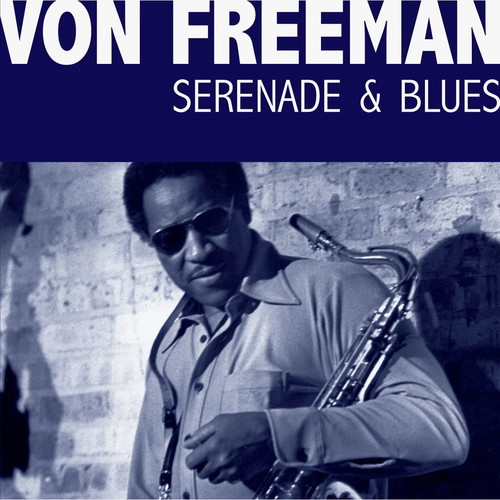
Serenade & Blues
On Serenade & Blues, Von Freeman eases his Chicago tenor into an after‑hours glow, trading the swagger of Have No Fear for late‑night ballads and slow blues that stretch time without ever losing their bite.

Have No Fear
On Have No Fear, Von Freeman turns a 1975 marathon session into a fiercely personal manifesto, his elastic Chicago tenor pouring blues, bravado and vulnerability into performances that sound both off‑the‑cuff and obsessively shaped.

6 Duos (Wesleyan) 2006
On 6 Duos (Wesleyan) 2006, Anthony Braxton and John McDonough turn a teacher–student bond into a finely wired brass–reeds colloquy, shuttling between Braxton systems, McDonough themes, open improvisation and Sousa with disarming clarity and wit.

Silver Cornet
On Silver Cornet, Bobby Bradford and Frode Gjerstad turn a one‑night Baltimore stop into a fiercely conversational blowout, their quartet with Ingebrigt Håker Flaten and Frank Rosaly mapping free jazz as living, mobile history.

Spontaneous Music Ensemble
On this meeting with the Spontaneous Music Ensemble, Bobby Bradford steps into John Stevens’ London laboratory and, alongside Trevor Watts, Julie Tippetts, Bob Norden and Ron Herman, turns free improvisation into a fiercely alert, shape‑shifting chamber music.

Live at Yoshi's 1994
On Live at Yoshi’s 1994, Mal Waldron and Steve Lacy turn a decades‑deep partnership into a single, extended act of listening, folding Monk, Ellington, Strayhorn and their own themes into a stark, tensile dialogue where every note feels earned.

Numbers 1&2
On Numbers 1 & 2, Lester Bowie joins Malachi Favors, Joseph Jarman and Roscoe Mitchell in a pre‑Art Ensemble crucible where AACM discipline, raw timbral play and open‑form swing coalesce into a blueprint for the Chicago future.

Black & Beautiful / Soul & Madness
Deluxe edition, housed in a reverse board printed sleeve with printed inner sleeve. Three LPs came out on Jihad, the label Amiri Baraka ran out of his own house in Newark. Two of them - Sonny's Time Now and A Black Mass - entered the canon of the New Thing decades ago. The third stayed a rumour: a title traded between collectors, a track a radio DJ might drop once a year, a record far more people had heard about than heard. Original copies surface rarely and sell for three figures. Black and Bea…