Magma
1001 Centigrades (LP)
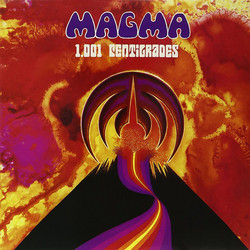
The title was not what Christian Vander wanted. The original plan was Magma 2, grey cover, the band's logo, first in a series conceived around the classical elements. It was Philips and producer Roland Hilda who imposed the name that stuck, drawing a literal inference from the band's name, and who commissioned the erupting volcano for the cover. Hilda is credited as producer; his actual contribution to the record, as Vander later acknowledged, stopped more or less there. What is pressed into the vinyl is almost entirely the result of six days of sessions in April 1971 at Michel Magne's studios in Herouville, with a band still redefining itself after the departure of guitarist Claude Engel, who was not replaced. No guitar on the record: a structural decision that would define Magma's sound for the following decade.
The lineup that recorded 1001° Centigrades is among the most significant in the band's entire history. Klaus Blasquiz on vocals, François Faton Cahen on piano and Fender Rhodes, Francis Moze on bass, Teddy Lasry on clarinet, saxophone and flute, Yochk'o Seffer on saxophone and bass clarinet, Louis Toesca on trumpet. Side A is occupied entirely by Rïah Sahïltaahk, twenty-two minutes composed by Vander telling the story of the Kobaïan who chose to remain on Earth when the others departed, certain he could convert its people to the Kobaïan spirit. He failed, and was left alone. The music moves through episodes connected by rhythmic rather than melodic logic: brass advances and recedes, voices layer into choral structures that owe nothing to any Western choral tradition, Vander strikes with a disciplined violence that jazz had shown was possible, Coltrane had pointed in the direction, and Magma had found its own language in which to translate it. Side B carries two compositions by other band members: Lasry's "Iss" Lanseï Doïa and Cahen's Ki Ïahl Ö Lïahk, both closer to free jazz-rock than to the zeuhl that would dominate subsequent work, a territory shared in those years with Soft Machine and the French scene around Nucleus. It is the last time such distinct compositional voices coexist in Magma's catalogue; from here, Vander would assume increasingly total control.
Mëkanïk Dëstruktïẁ Kömmandöh (1973) is often the entry point into the Magma catalogue, and for good reason: it is the moment zeuhl becomes a complete and unmistakable language. 1001° Centigrades is the moment immediately before, when that language was still forming, visibly stretched between what Magma had been and what it was becoming. Vander himself was not satisfied with the recording of Rïah Sahïltaahk; in 2014 he released a completely rearranged version, brass sections replaced by female choral voices. The original record remains an irreplaceable document regardless: the tension of a group inventing something without yet having a name for what it was doing. After this, Cahen and Seffer would form Zao; Moze would join Gong. The lineup dissolved almost immediately after the sessions, which makes the record feel even more like a sealed moment.
The GM Records reissue returns the album to vinyl in the form closest to the original Philips pressing. For those coming from MDK or Köhntarkösz it is the map of what preceded them; for those arriving from the European avant-garde and the more radical end of jazz, it is the point at which to understand why Magma remains, more than fifty years on, a case without equivalent.