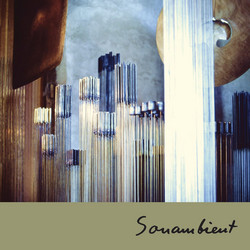
Catherine Christer Hennix
Central Palace Music (From 100 Model Subjects For Hegikan Roku)
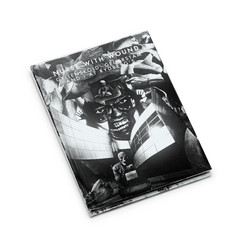
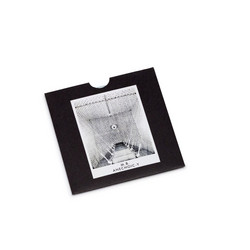
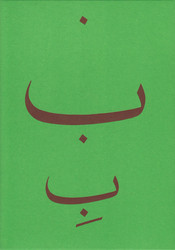
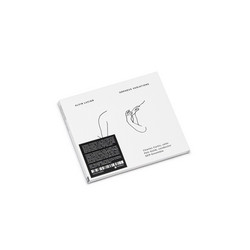
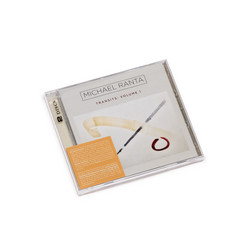
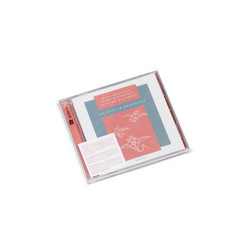
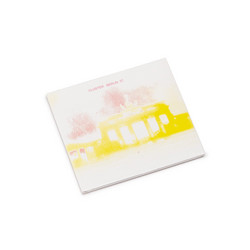
CD in a letterpressed sleeve, first pressing of a thousand. One track, forty-five minutes and forty-seven seconds. Credited to The Deontic Miracle: Catherine Christer Hennix on Renaissance oboe, custom sine wave generators and live electronics, Peter Hennix on Renaissance oboe, Hans Isgren on sheng.
The oboes are the point. Not modern conservatoire instruments but Renaissance oboes, with the older bore and fingering, amplified, and set against sine tones from generators Hennix had built for the purpose. A pre-Baroque double reed is an unstable and slightly rough thing; a sine wave is the smoothest sound there is. Putting them in the same tuning is the whole experiment.
It was recorded in March 1976 at the Moderna Museet in Stockholm, during an eight-day festival Hennix had organised there. She called it Brouwer's Lattice, after L.E.J. Brouwer, the Dutch intuitionist mathematician, and the programme included work by La Monte Young, Terry Riley and Terry Jennings alongside her own. She was showing an installation in the same building called Toposes and Adjoints, which is category theory. The titles across the project come from the Hegikan Roku, the Japanese reading of the Blue Cliff Record, a collection of Chan koans.
So far as anyone has established, this was the Deontic Miracle's only public performance. Hennix later described them as the most rejected band ever formed in Sweden, and the tape sat unheard for forty years.
She was born in Stockholm in 1948, joined the Elektronmusikstudion shortly after it opened, became a disciple of Pandit Pran Nath in 1973, taught logic at the MIT Artificial Intelligence Laboratory in the 1970s, and worked for years with the ultrafinitist Alexander Esenin-Volpin. She died in Istanbul on 19 November 2023.
Writing in The Quietus, Dustin Krcatovich called her among the more unjustly overlooked of the early minimalists, and this recording reedier and harsher than what she did later. Her own stated aim was a sustained out-of-body experience in an altered state of consciousness.
Central Palace Music, performed by Catherine Christer Hennix's just-intonation ensemble The Deontic Miracle, is the first in a series of archival Hennix releases to be issued via Imprec. This previously unheard piece was taken from an eight day festival organized in the Spring of 1976 at the Museum of Modern Art in Stockholm. The group features Catherine Christer Hennix on Renaissance oboe and custom sinewave generators, Peter Hennix on Renaissance oboe and Hans Isgren on sheng.
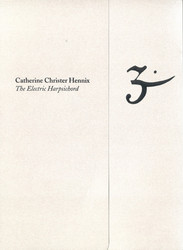
Central Palace Music is packaged in a deluxe letterpressed package and is being released at the same time as a recent recording of Hennix's new ensemble live at Issue Project Room.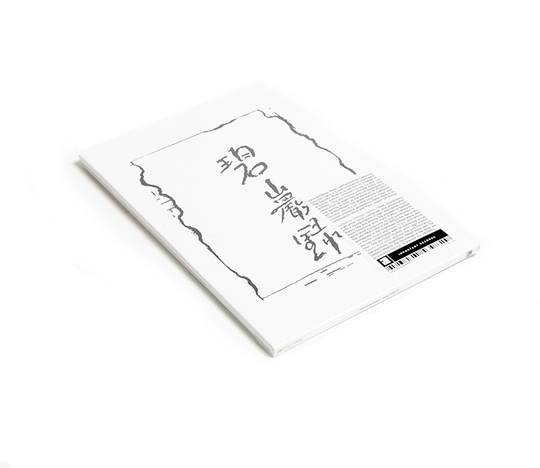
"...Hennix has created a sound that reliably taps into our subconscious and frees us from linear time..." The Quietus
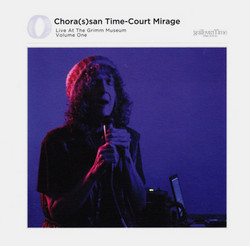
Catherine Christer Hennix (1948, Stockholm) is an artist, poet, composer and philosopher with a strong interest in logic and formal music theory. She was among the pioneers in Sweden experimenting with main-frame computer generated composite sound wave forms in the late 1960's and in the 1970's she was a key protagonist in the Downtown School along with La Monte Young and Henry Flynt, with whom she has collaborated with on numerous occasions. She pursued studies with raga master Pandit Pran Nath and led the just intonation live-electronic ensembles Hilbert Hotel and The Deontic Miracle, the recordings of the latter are presently being released by Important Records. She was a professor of mathematics and computer science and assistant to and coauthor with A.S. Esenin-Volpin for which she was given the Centenary Prize Fellow Award by the Clay Mathematics Insitute in 2000. Hennix's interest in drone music and the meditative, trance-like state it induces is apparent in her exploration of similar music in many other cultures and traditions, drawing inspiration from the Japanese Gagaku music and the early, vocal, thirteenth-century music of Perotinus and Leoninus, for example. In 2003 she returned to computer generated composite sound wave forms now called Soliton(e)s of which Soliton(e) Star was the first result. Subsequently she formed the just intonation ensemble The Choras(s)an Time-Court Mirage which performs Blues Dhikir al- Salam (Live at the Grimmuseum, vol. 1, Berlin, 2011, Important Records 2012). In 2012 Henry Flynt asked Hennix for a new, expanded realization of ISE for an installation at ZKM in Karlsruhe, Germany, to be featured in his retrospective/ prospective show Henry Flynt Activities 1959 – at ZKM. In response Hennix realized a 4-channel composition, Rag Infinity/Rag Cosmosis, her first 4-channel computer assisted composition since 1969.