Chris Watson
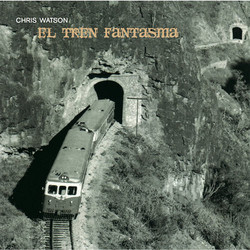
El Tren Fantasma (The Signal Man's Mix)
Before Chris Watson became the man who put microphones where you cannot put your ears - inside glaciers, beneath elephant feet, among snapping alligators in the Everglades - he was one-third of Cabaret Voltaire, splicing tape loops in a Sheffield attic, dreaming of Pierre Schaeffer and William Burroughs and the infinite possibilities of magnetic oxide. That was 1973. By 1981 he'd left the band and joined Tyne Tees Television, beginning a journey that would take him from industrial noise to the whisper of a cheetah's breath against a baobab tree.
El Tren Fantasma (The Signal Man's Mix) is what happens when those two lives finally collide on vinyl.
The source material comes from Watson's fourth solo album for Touch, El Tren Fantasma - itself a sonic reconstruction of a journey that no longer exists: the Ferrocarriles Nacionales de México, coast to coast, Pacific to Atlantic, Los Mochis to Veracruz. Watson rode the rails as sound recordist for a BBC documentary in the late '90s. By the time he assembled the album in 2011, the passenger service had become a ghost. Hence the title. Hence the weight.
But where the album is documentary - ten tracks, ten stations, the narrative arc of a journey through Sierra Tarahumara and Chihuahua and Mexico D.F. - this 12" is something else entirely. Two tracks. Two sides. The field recordings subtly augmented by slow ambient drones, spatial harmonics bleeding into the mechanical clatter of freight cars. Think musique concrète meeting dub techno in a deserted railyard at 3am. Think the rhythm of the rails as a meditation device. Think the first concrete sound composition ever made - Schaeffer's Étude aux chemins de fer from 1948 - dragged into the 21st century and given a heartbeat.
Side A, El Divisadero (The Telegraph), builds from station ambience into a locked groove of train sounds and bass frequencies, a voice announcement cutting through like a ghost conductor calling a phantom platform. Side B, Veracruz (The Tunnel), is pure environmental recording - freight trains roaring through like thunder, then receding into distance, leaving only insects and wind. The vinyl was cut at Transition. The etchings in the run-out grooves read "LOOK OUT" and "Below there" - a nod to Charles Dickens's railway ghost story The Signal-Man, from which this remix takes its name.
Field recordings as the glue between the organic and the mechanical. The sound of a journey that has passed into history, pressed into wax so you can take it again.