Jani Christou
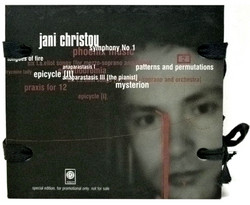
Enantiodromia / Praxis / Epicycle / Anaparastasis III / Mysterion Prolog / Mysterion Sprechertext (LP)
LabelEdition RZGenreExperimental
Out of stock
Tracked express shipping from Italy, no customs or import VAT in the EU. Shipping costs
condition (record/cover): NM / NM
Insert included. | One of the great records of twentieth-century music. Jani Christou (1926–1970) is among the most singular and still insufficiently known composers the century produced — a Greek thinker born in Heliopolis, Egypt, educated in philosophy at Cambridge under Ludwig Wittgenstein and Bertrand Russell, privately taught in music by H. F. Redlich and orchestration by Angelo Francesco Lavagnino, briefly present at lectures by Carl Jung in Zurich, and ultimately settled in Athens, where he composed until his death in a car accident on his forty-fourth birthday in 1970. He had invented his own notation system using psychological and symbolic cues alongside traditional staff notation. He had developed the concept of the Anaparastasis — a ritual reenactment, a poly-artistic event that could not be reduced to any single medium. He was completing a full operatic setting of the Oresteia. What he might have done next is among the century's unanswerable questions.
The five works on this Edition RZ LP — Enantiodromia (1965–68, for orchestra), Praxis (1966–69, for string orchestra and piano), Epicycle (1968, tape version, for instruments, actors and voices), Anaparastasis III "The Pianist" (1968–69, for ensemble, continuum tapes and an actor), and the Prologue and Narrator-text from Mysterion (1965–66, for narrator, actors, three choirs, orchestra and tapes) — document the final phase of his creative life: the one in which he had moved furthest from any recognizable precedent, using improvisation within rigorously defined parameters, integrating theatrical action with musical sound, and allowing philosophical urgency — his obsession with death, with the archaic, with what he called the "life-death boundary" — to restructure the very nature of musical composition. The cataclysmic orchestral resolution of Enantiodromia, the proto-aleatory openness of Epicycle, the whispered voices of Mysterion — this is music that reaches toward other dimensions and, against all odds, touches them. Edition RZ, Ed. RZ 1006, 1992. Among the finest things the label ever released.
Release notes
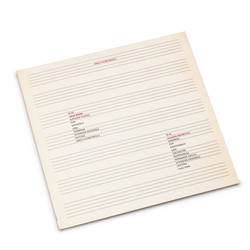
Enantiodromia (1965-68) for orchestra (with amplified piano and percussion). Praxis (1966-69) for string orchestra and piano. Epicycle (1968) for instruments, actors and voices (continuum and events) - tape version. Anaparastasis III "The Pianist" (1968-69) for soloist, ensemble and continuum (tapes). Mysterion (1965-66) for narrator, actors, 3 choirs, orchestra and tapes. Includes 8-page, 12" square booklet with liner notes in German and English.
| A1 | Enantiodromia | 11:54 | |
| A2 | Praxis | 9:35 | |
| B1 | Epicycle | 9:35 | |
| B2 | Anaparastasis III "The Pianist" | 11:11 | |
| B3 | Mysterion Prolog Und Sprechertext | 5:00 |
- Jani Christou
- Composed By
- Bernard Stein, Nicolaus Ott
- Design
- George S. Leotsakos
- Liner Notes
- Dieter Scheyhing
- Liner Notes [Translations]
- Laurie Schwartz
- Liner Notes [Translations]